“Quick Answer: Most lenders use the 28/36 rule: your monthly housing payment shouldn’t exceed 28% of gross monthly income, and your total debt payments (housing + car loans + student loans + credit cards) shouldn’t exceed 36%. On an H1B salary, this rule applies exactly the same way it does for U.S. citizens.”
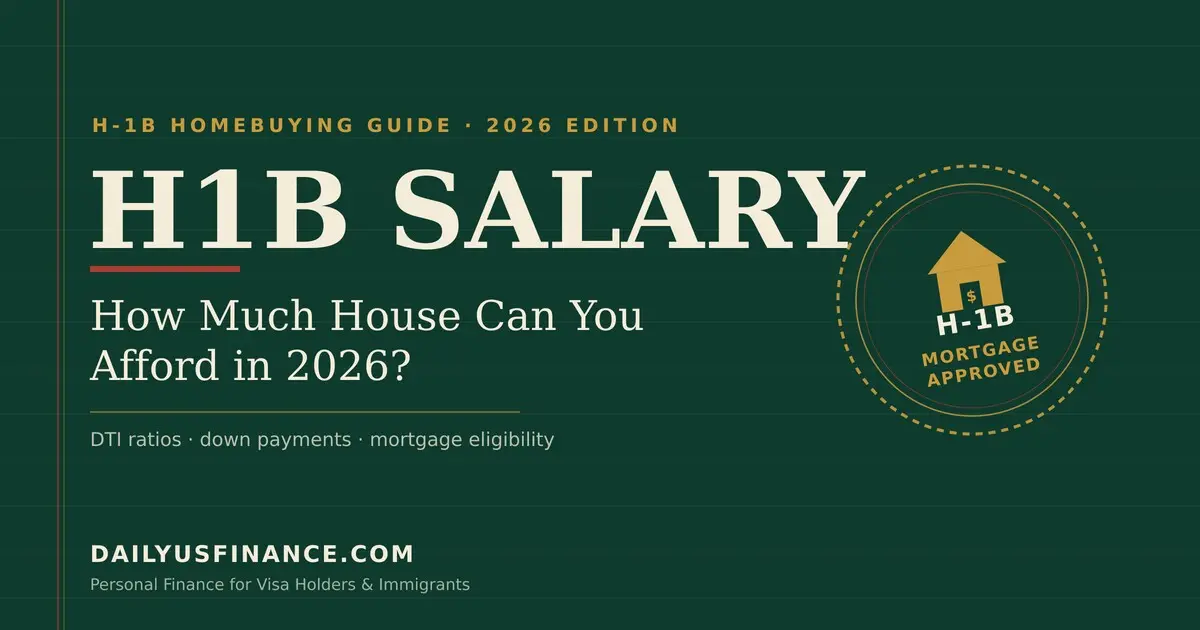
Find out how much house you can afford on an H1B salary in 2026, including DTI ratios, down payments, and mortgage options for visa holders.
How Much House Can You Afford on an H1B Salary in 2026?
If you’re earning a strong H1B salary and wondering whether you can buy a home in the U.S., the short answer is yes — H1B visa holders can qualify for a mortgage, and most lenders will let you spend roughly 28–36% of your gross monthly income on housing. The exact number depends on your salary, debt load, down payment, and credit history, not your visa status alone.
This guide breaks the question down the way a lender actually evaluates it, so you can walk into a mortgage conversation with real numbers instead of guesswork.
Here’s roughly what that looks like at common H1B salary levels in 2026, assuming a 20% down payment and a mortgage rate around 6.5–7%
- $90,000/year salary → ~$2,100/month housing budget → home price range roughly $300,000–$330,000
- $120,000/year salary → ~$2,800/month housing budget → home price range roughly $400,000–$440,000
- $150,000/year salary → ~$3,500/month housing budget → home price range roughly $500,000–$550,000
- $180,000/year salary → ~$4,200/month housing budget → home price range roughly $600,000–$660,000
These ranges shift with your down payment size, property taxes, HOA fees, and local insurance costs, so treat them as a starting point rather than a firm number. The median H1B salary reported through Labor Condition Applications is well above the U.S. median household income, which is one reason many H1B holders qualify for more house than they initially expect.
Can H1B Visa Holders Even Get a Mortgage in the US?
Yes. Being on an H1B does not disqualify you from a mortgage — U.S. mortgage law treats you as a “non-permanent resident alien,” a recognized borrower category, not an obstacle. You do not need a green card or U.S. citizenship to buy a home.
Loan options commonly available to H1B holders include:
- Conventional loans (Fannie Mae/Freddie Mac) — the most common route, usually requiring a valid work visa, Social Security number, and steady income history
- FHA loans — technically available to non-permanent residents in some cases, though documentation requirements are stricter than for conventional loans
- Portfolio or “foreign national” loan programs — offered by some regional and international banks specifically for visa holders, sometimes with higher down payment requirements but more flexible income/credit documentation
What Documents Do Lenders Ask For?
Expect to provide your valid H1B approval notice (I-797), passport, visa stamp, Social Security number, two years of tax returns, recent pay stubs, and bank statements. Lenders want to see a consistent income and employment pattern, the same as they would for any borrower.
What Debt-to-Income (DTI) Ratio Do Lenders Use for H1B Borrowers?
Lenders calculate DTI the same way for H1B applicants as for anyone else: total monthly debt payments divided by gross monthly income. Most conventional lenders cap this at 43–50%, though staying closer to 36% gives you more room and better approval odds.
Front-end DTI (housing costs only): ideally under 28%
Back-end DTI (all debts including housing): ideally under 36%, with 43–50% as the outer limit for most programs
If you’re carrying student loan debt, an auto loan, or significant credit card balances, this is usually the single biggest factor limiting how much house you can afford — more than visa status.
How Much Down Payment Does an H1B Visa Holder Need?
Most H1B borrowers put down between 10% and 20%, though some conventional programs allow as little as 3–5% down with mortgage insurance. Down payment size directly affects both your loan approval odds and your monthly payment.
3–5% down — possible through certain conventional programs, but usually requires stronger credit and a longer U.S. credit history
10–15% down — a common middle ground for H1B applicants with 2+ years of U.S. credit history
20%+ down — avoids private mortgage insurance (PMI) and is often recommended for visa holders because it signals lower risk to underwriters and can offset a shorter credit file
“”H1B applicants are approved on the same financial merits as anyone else — income, debt ratio, credit, and reserves. The visa itself is rarely the blocker; a thin U.S. credit file usually is.”
Do I Need US Credit History to Qualify for a Mortgage?
Most conventional lenders want at least two years of U.S. credit history, but it’s not an absolute requirement. Some banks accept alternative credit documentation, and a small number of lenders will factor in international credit history.
Build U.S. credit fast: a secured credit card, a credit-builder loan, or becoming an authorized user can establish a file within 6–12 months
Alternative credit documentation: on-time rent payments, utility bills, and phone bills can sometimes substitute for a traditional credit score with manual-underwriting lenders
International credit transfer: services like Nova Credit let some lenders review credit history from your home country, though availability varies by bank and nationality
If you’re newer to the U.S., focus on both your credit file and your down payment cushion — a larger down payment can offset a shorter credit history in many underwriting models.
Does H1B Renewal or Transfer Status Affect Mortgage Approval?
It can, but it’s manageable. Lenders generally want your visa to be valid for at least the near-term future — often through the loan’s first year — and want to see a stable employment and sponsorship history rather than guaranteed permanent status.
Lenders typically ask for your current H1B approval and prior extension history to show a pattern of continued sponsorship
A pending H1B extension or transfer isn’t automatically disqualifying if your employment history is otherwise strong
Some lenders are more conservative around visa timing than others, so shopping multiple lenders — especially ones with dedicated visa-holder mortgage programs — can materially change your approval odds
How to Increase How Much House You Can Afford on an H1B Salary
A few practical levers move the needle more than anything else:
- Pay down existing debt before applying to lower your DTI ratio
- Save a larger down payment to reduce PMI and monthly payments
- Build U.S. credit early, even in your first year on H1B
- Compare multiple lenders, including banks with dedicated immigrant/visa-holder mortgage desks
- Get pre-approved before house hunting so you know your real number, not an estimate
“Home prices, mortgage rates, and lending guidelines shift throughout the year, so check current figures with a lender or a source like Freddie Mac before finalizing your budget.”
FAQ
How much house can I afford on a $120,000 H1B salary?
Using the 28/36 rule with a 20% down payment and current average rates, a $120,000 salary generally supports a home in the roughly $400,000–$440,000 range, though your specific number depends on debt load, credit score, and location.
Can H1B visa holders get a conventional mortgage in the US?
Yes — H1B holders are eligible for conventional mortgages as non-permanent resident aliens, provided they have a valid visa, Social Security number, steady income, and typically two years of U.S. work and credit history.
Do I need a green card to buy a house on H1B?
No, a green card is not required. Many H1B holders successfully buy homes using conventional loans or dedicated foreign national/visa-holder mortgage programs.
What credit score do H1B visa holders need for a mortgage?
Most conventional lenders look for a minimum credit score around 620, though 680+ typically unlocks better rates; some manual-underwriting programs will consider alternative credit history for those without a long U.S. credit file.
Does an H1B visa expiring soon hurt mortgage approval?
It can raise questions, but it’s not automatically disqualifying — lenders look at your overall employment and sponsorship history, and some visa-focused lenders are more flexible than others on this point.
Author Bio:
Allwin is the founder of DailyUSFinance.com, where he writes about personal finance, credit, and homeownership for immigrants and visa holders navigating the U.S. financial system. He covers practical, first-generation-focused money topics
- Trump Account vs. 529 Plan: Which Wins in 2026?
 In this article Trump Account vs. 529 Plan: Which Should You Use in 2026? What Is a Trump Account, and How Is It Different From a 529 Plan? A few structural facts worth knowing upfront: The Real Numbers: What Would Each…
 - Retirement-Maxxing: Best Way to Max Your 401(k) in 2026In this article Retirement-Maxxing: What It Is and How to Max Out Your 401(k) in 2026 What Is Retirement-Maxxing? Why Is Gen Z Retirement-Maxxing Right Now? What Are the 2026 Retirement Contribution Limits? How to Actually Start Retirement-Maxxing Can Self-Employed and…
- Trump Accounts for Kids: Complete 2026 Parent GuideIn this article Trump Accounts Explained: Complete 2026 Parent's Guide Where Things Actually Stand as of August 2026 Who Qualifies for a Trump Account? (Eligibility Rules for 2026) What About Mixed-Status and Immigrant Families? Can I Open One With Only an…
- Trump Account Employer Match: Real Tax Savings 2026In this article Trump Account Employer Match 2026: Real Tax Savings by Income What Is the Trump Account Employer Match, Exactly? How Much Is the Match Actually Worth at Your Income? Trump Account vs. 529 vs. Custodial Roth IRA: Which Should…
- Credit Card Debt: Compare 0.99% vs 0% APR CardsIn this article Balance Transfer Cards Compared: Who Actually Qualifies to Tackle Credit Card Debt at 0.99% vs. 0% APR What's the Real Difference Between a 0.99% and a 0% Intro APR Balance Transfer Card? How Much Do You Actually Need…