“What Is a Trump Account? (Quick Answer) : A Trump Account is a tax-deferred savings account for children under 18, formally created under Internal Revenue Code Section 530A and structured as a special type of traditional IRA. It’s funded by a mix of a one-time $1,000 federal deposit (for eligible kids), family contributions, and optional employer contributions, and the money grows tax-deferred in low-cost U.S. stock index funds until the child turns 18.”
Trump accounts for kids explained: eligibility, the $1,000 deposit, real 18-year growth math, taxes, and how to open one in 2026.
Trump Accounts Explained: Complete 2026 Parent’s Guide
If you’ve heard about “Trump accounts for kids” and wondered whether they’re actually worth setting up for your family, here’s the short version: they’re real, they’re live, and for most families the free money is worth claiming — but the account itself is more nuanced than the headlines suggest. Trump Accounts are a new type of tax-advantaged retirement account for children under 18, created by the 2025 tax law and officially opened for contributions on July 4, 2026. They come with a possible $1,000 government deposit, a $5,000 annual contribution cap, and tax rules that are closer to a traditional IRA than to a 529 plan.
This guide skips the surface-level mechanics you’ve probably already read elsewhere and goes straight to what parents actually want to know: what the account is worth in real dollars over 18 years, how it stacks up against a 529 or Roth IRA, what happens if you’re an immigrant family or a freelancer, and how to actually get the money.
The accounts came out of the “One Big Beautiful Bill Act“ (also called the Working Families Tax Cut Act), signed into law on July 4, 2025, and they became active for contributions exactly one year later, on July 4, 2026.
Where Things Actually Stand as of August 2026
Because this program rolled out in stages, a lot of the coverage online is now outdated or mixes up what’s final versus what’s still proposed. Here’s the current state of play:
- Live and operating: The accounts themselves, the $1,000 seed deposit election, and individual/family contributions up to $5,000/year.
- Live but recently expanded: Employer contributions and pretax payroll deductions through a workplace cafeteria plan — Treasury issued guidance on this August 10, 2026.
- Still technically proposed: The detailed regulations governing how employers must administer payroll-based Trump Account programs (nondiscrimination testing, plan documents, etc.). Those rules (REG-101355-26) are open for public comment through September 25, 2026, with a hearing scheduled for October 15, 2026, before they’re finalized.
- Still undetermined: How Trump Account balances and withdrawals will be treated on the FAFSA for college financial aid.
- Check current figures: Contribution limits are indexed for inflation starting in 2028, and employer adoption numbers are changing monthly. Verify current limits at TrumpAccounts.gov or IRS.gov before you plan around a specific dollar figure.
Who Qualifies for a Trump Account? (Eligibility Rules for 2026)
Click here for :Trump Account Employer Match: Real Tax Savings 2026
Your child qualifies for a Trump Account if they’re under 18 and have a valid Social Security number — no earned income, no minimum age, and no income limit on the family. That’s it for the account itself. The free $1,000 deposit has narrower rules layered on top.
The Three Core Requirements
To open an account for a child:
- Under 18 on December 31 of the year the account is opened
- Valid Social Security number (not an ITIN — this is the one hard line in the program)
- Account opened via IRS Form 4547 or through TrumpAccounts.gov / the official Trump Accounts app
To also receive the one-time $1,000 federal pilot deposit, the child must additionally be:
- A U.S. citizen
- Born between January 1, 2025, and December 31, 2028
- A child born outside that window, or who isn’t a U.S. citizen, can still have a Trump Account opened and funded — they just won’t get the free $1,000.
What About Mixed-Status and Immigrant Families?
This is the part most articles skip, and it matters a lot if you’re an ITIN filer, a green card holder, or part of a mixed-status household. The eligibility test applies to the child, not the parent:
- The parent or guardian opening the account does not need an SSN or U.S. citizenship. You can use your ITIN on the application.
- The child must have their own valid SSN to open any Trump Account at all.
- A child who is a lawful permanent resident (not a citizen) with a valid SSN can have an account opened and funded normally, but is not eligible for the $1,000 pilot deposit, since citizenship is one of the three conditions for that piece specifically.
- If your child’s immigration status changes and they later receive an SSN, they become eligible to open an account at that point.
For families with immigration-related concerns about sharing information with a federal agency, that’s a legitimate consideration to weigh — the eligibility rules themselves don’t look at parents’ immigration status, but you should decide based on your own comfort level, not just the technical rules.
Can I Open One With Only an ITIN?
As the parent or guardian, yes — an ITIN is sufficient for you to open and administer the account on behalf of an eligible child. It’s the child’s number that has to be an SSN. If you’re unsure which number your child has, that’s worth confirming before you start the Form 4547 process, since a mismatch is the single most common reason applications get held up.
How Much Can You Contribute, and How Does the $1,000 Seed Deposit Work?
Total contributions to a Trump Account are capped at $5,000 per year per child, combined across every contributor — parents, grandparents, friends, and employers all share that one number. Employers can contribute up to $2,500 of that total, tax-free to the employee. On top of that, eligible kids can get a one-time $1,000 deposit from the federal government that doesn’t count against the cap at all.
- The $5,000 Annual Limit, Explained
- The $5,000 combined limit applies from birth through the year before the child turns 18 (this window is called the “growth period”).
- It’s indexed for inflation starting in 2028; for 2026 and 2027 it stays flat at $5,000.
- Contributions from individuals (parents, grandparents, friends, the child themselves once older) are made with after-tax dollars — there’s no tax deduction for putting money in, unlike a traditional 401(k) or deductible IRA.
- Contributions from charities and state/local governments don’t count toward the $5,000 cap at all.
- If two working parents each have an employer offering the $2,500 contribution, a married couple filing jointly can direct the entire $5,000 cap to employer money in a single year — even if excess contributions from other sources would then need to stop.
- The One-Time $1,000 Government Deposit
Children born January 1, 2025 through December 31, 2028 who are U.S. citizens with a valid SSN can receive a one-time $1,000 deposit from the Treasury, as long as a parent or guardian files the election. It doesn’t require any contribution from you, and it doesn’t reduce your $5,000 annual room.
Some private philanthropic programs have also layered additional seed money on top for specific groups — for example, pledges tied to certain ZIP codes or states have added $250 contributions for kids who don’t qualify for the federal $1,000. Whether your child qualifies for one of these extra programs depends on birth year, location, and household income, so check TrumpAccounts.gov directly rather than assuming.
Employer and Pretax Payroll Contributions
Click Here for: Is the Trump Account App Legit? 2026 Guide & Scam Alert
As of the August 2026 Treasury guidance, there are two separate employer-linked channels, and it’s easy to conflate them:
- Employer contribution: Your employer puts money directly into your child’s Trump Account — up to $2,500/year, tax-free to you, but it still counts toward FICA/FUTA payroll taxes on the employer’s side.
- Employee pretax payroll deduction: If your employer sets up a Trump Account Contribution Program (TACP) under a cafeteria plan, you can elect to divert part of your own paycheck into your dependent’s account pretax, lowering your taxable income.
- Both channels share the same $2,500 sub-limit toward the $5,000 total. Neither is automatic — your employer has to opt in and set up a written plan.
What Is a Trump Account Actually Worth? Real Numbers for a $75K vs. $250K Family
Quick answer: Assuming a 7% average annual return (illustrative, not guaranteed), a child who gets the $1,000 seed deposit and no other contributions would have roughly $3,380 by age 18. A family that also contributes $2,000/year pretax through an employer plan would end up with roughly $76,000 — and because contributions are pretax, the actual out-of-pocket cost differs by income bracket.
Almost every other Trump Account article describes the contribution rules without ever showing what the account is actually worth. Here’s the math, using a hypothetical newborn in 2026, an illustrative 7% average annual return net of the account’s 0.10% fee cap, and 2026 federal tax brackets (married filing jointly). This is a simplified model — it ignores state taxes, assumes contributions happen every year without interruption, and assumes market returns that are never actually guaranteed.
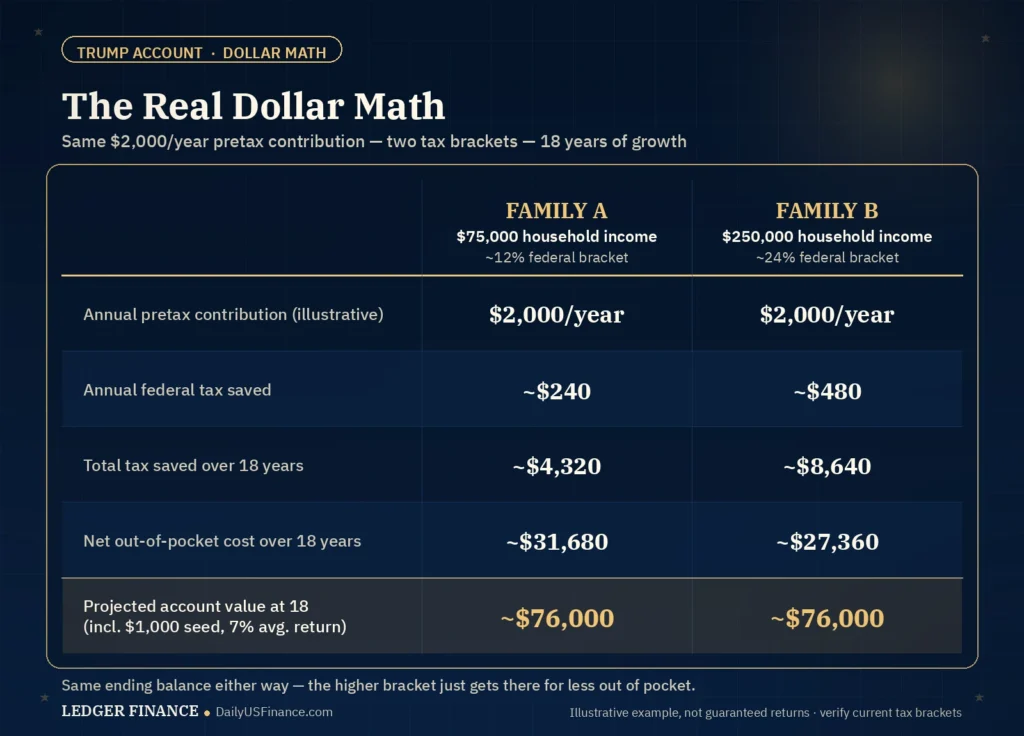
The account balance ends up the same for both families because growth doesn’t care about your tax bracket — what differs is how much it actually costs you to get there. The higher earner effectively gets a bigger discount on the same outcome, which is the same dynamic that makes any pretax account (401(k), traditional IRA, FSA) more valuable in a higher bracket.
For context on the ceiling and floor of what’s possible:
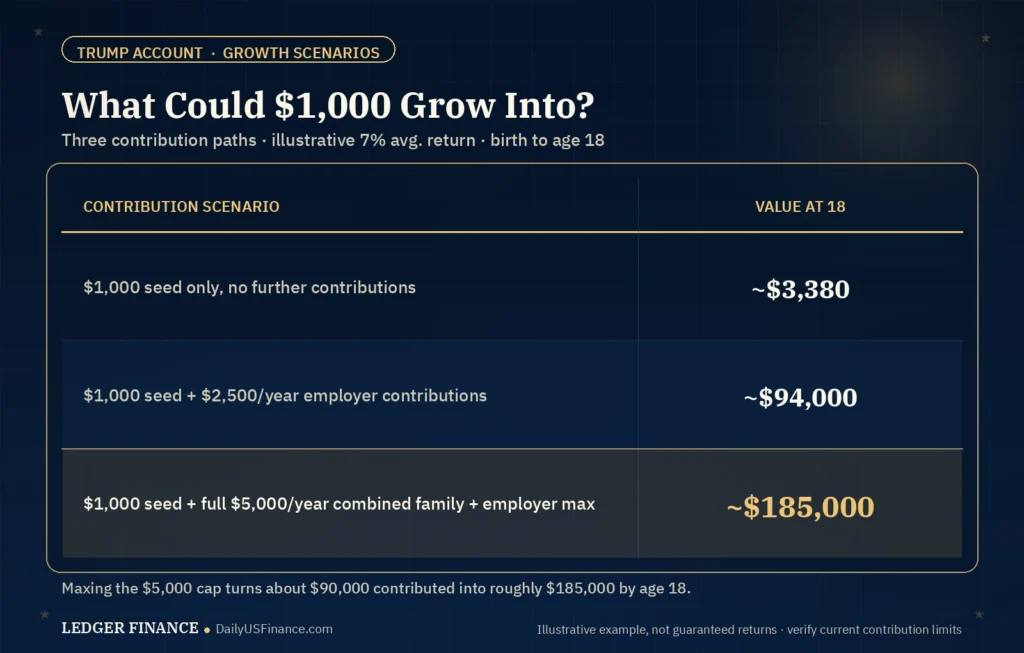
That top scenario requires $90,000 in total contributions over 18 years to hit roughly $185,000 — meaning about $94,000 of that final balance is investment growth, not money you put in. That’s the pitch for starting early: the earlier the contributions begin, the more time each dollar has to compound before the account converts to a standard IRA at 18.
Trump Account vs. 529 vs. Roth IRA vs. UTMA/UGMA: Which Should You Actually Use?
Quick answer: There’s no single best account — each one is built for a different job. A Trump Account is the only one of the four that requires no earned income and comes with free government money, but it has the least favorable tax treatment on withdrawal. Most financial planners suggest layering more than one account rather than picking just one.
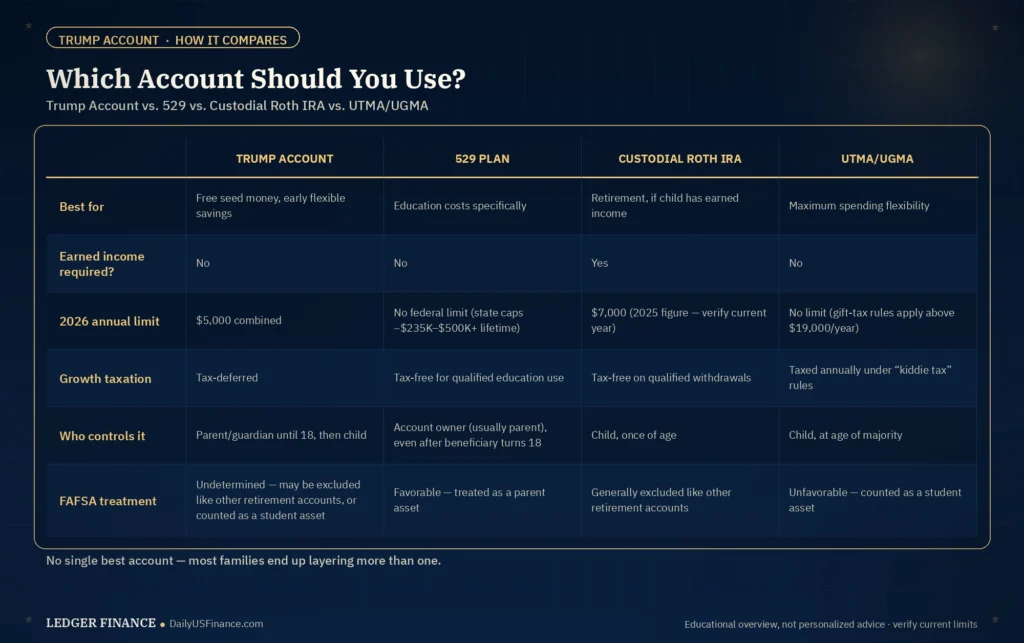
A practical way to think about it: use a 529 as your primary education fund because its tax treatment for tuition is unmatched and it’s assessed favorably on the FAFSA. Open the Trump Account anyway to claim the free $1,000 and any employer match — it costs nothing to open.
Once your child has a summer job or part-time earnings, layer in a Roth IRA for tax-free retirement growth. Reach for a UTMA/UGMA only if you want money that can be spent on absolutely anything before age 18, understanding that it will count against financial aid.
How Is the Money Taxed When Your Child Withdraws It?
Quick answer: Almost nothing can be withdrawn before age 18. After that, the account converts automatically into a regular traditional IRA, and ordinary IRA withdrawal rules apply — income tax on the growth and any employer/government money, plus a possible 10% early withdrawal penalty before age 59½, with a few exceptions.
- During the growth period (birth to age 17): Withdrawals are essentially not allowed. The only exceptions are certain rollovers, correcting an excess contribution, or a payout following the child’s death. There’s no hardship exception, unlike a 401(k).
- At age 18: The account automatically converts to a standard traditional IRA. Your child becomes the account owner and can invest more broadly — not just the S&P 500-style index funds required during the growth period.
- What’s taxed on withdrawal: Money you contributed as an individual was already after-tax, so that portion isn’t taxed again. But investment growth, the $1,000 government seed, and any employer contributions are taxed as ordinary income when withdrawn — not the lower capital gains rate, and not tax-free the way qualified Roth or 529 withdrawals are.
- The 10% early withdrawal penalty applies to withdrawals before age 59½, with standard IRA exceptions available — including qualified higher education expenses and up to $10,000 for a first-time home purchase.
- A notable option at 18: Because the balance is relatively small early on, some families convert the Trump Account into a Roth IRA right when the child turns 18, paying tax on the conversion while the child is likely in a very low tax bracket (or has no income yet), locking in tax-free growth from that point forward. This is a real strategy worth discussing with a tax professional — it is not automatic and triggers a tax bill in the conversion year.
On financial aid: As of August 2026, the Department of Education hasn’t issued official guidance on how Trump Accounts are reported on the FAFSA. One reasonable expectation, since the account is structured as an IRA, is that it could be excluded from the asset test the way other retirement accounts are — which would be a real advantage over a UTMA. But others expect it could instead be assessed like a student asset, at a steeper rate than a parent-owned 529.
Until the Department of Education says otherwise, don’t build a financial-aid strategy around either assumption — but that uncertainty isn’t a reason to skip the free $1,000, since in the worst case you can’t lose more aid than the account itself is worth.
How Do You Get Your Employer to Offer This? (An HR Playbook)
Quick answer: Most employers aren’t offering this yet, but adoption is accelerating fast — so a direct, low-friction ask to HR or benefits is worth making, especially now that Treasury has clarified the compliance framework.
The numbers explain why nobody’s written this guide before now: an April 2026 Mercer poll of nearly 350 employers found only about 4% planned to implement a Trump Account program in 2026 or 2027, with two-thirds deciding against it outright. A separate February 2026 Mercer poll found roughly 16% either planning to offer it or actively considering it. But as of mid-August 2026, Treasury says more than 50 companies — including several major financial firms — have already committed to contributing, and that number is expected to keep climbing now that the payroll mechanics have formal guidance behind them.
If your employer doesn’t offer it yet, here’s a practical way to raise it:
- Ask the right department. This typically sits with HR/Total Rewards or Benefits, not payroll alone — they’re the ones who’d need to set up a written plan document.
- Frame it as low-cost and low-liability. The Department of Labor has confirmed Trump Account programs generally fall outside ERISA, which is a materially lighter compliance lift than a 401(k) match. That’s worth mentioning if you’re pitching this to a smaller employer.
- Point to what’s required on their end. To offer it, an employer generally needs to maintain a separate written plan document, set up employee certification procedures, and provide required notices — similar in shape to setting up a dependent care FSA.
- Note the nondiscrimination rule if you work at a larger company. Employers can’t disproportionately favor highly compensated employees (generally those earning over $160,000 in 2026, plus officers and 5%+ owners) — at least 55% of the benefit has to reach non-HCEs. This is one of the open questions in the proposed regulations, so larger employers may reasonably wait for the October 2026 hearing before finalizing a program.
- Ask about both channels. Employers can offer a direct contribution, a pretax payroll deduction option for employees, or both — worth clarifying which one you’re actually asking for.
What If You’re Self-Employed or a Gig Worker?
Quick answer: You can’t create a pretax employer-style program for yourself, but you can still open and fund your child’s Trump Account directly as an individual, up to the same $5,000 annual cap — you just don’t get the pretax payroll advantage a W-2 employee might have.
This is a real gap in the program that Treasury’s own proposed regulations acknowledge directly: a self-employed person — defined broadly to include sole proprietors, partners, and more-than-2% S-corp owners, even ones who pay themselves a W-2 salary — is not eligible to participate in an employer-style Trump Account contribution program, even for their own business. You can set up such a program for your employees if you have them; you just can’t use it for yourself.
In practice, that means most freelancers, consultants, and gig workers are limited to the same path as any parent, aunt, or grandparent: contribute directly, after-tax, up to your share of the $5,000 combined cap. A few things worth knowing if that’s you:
- Automate it if your income is irregular. A recurring transfer during high-income months is easier to sustain than trying to hit the cap in one lump sum at tax time.
- Weigh it against your own retirement accounts. A SEP IRA or Solo 401(k) for your own retirement may offer a larger, tax-deductible contribution than routing extra cash into your child’s account — the Trump Account isn’t a substitute for your own retirement savings, and shouldn’t come before it if you’re behind on either.
- You still get the $1,000 seed if your child qualifies. Self-employment status has no bearing on the child’s eligibility for the federal deposit — only the child’s citizenship, SSN, and birth year matter for that piece.
How Do You Actually Open a Trump Account? (Step-by-Step)
- Confirm your child has a valid SSN. This is the one non-negotiable requirement.
- File IRS Form 4547, either through your IRS online account at IRS.gov or directly through TrumpAccounts.gov or the official Trump Accounts app.
- Elect the $1,000 deposit if your child was born 2025–2028 and is a U.S. citizen — this is included automatically when you file for an eligible child, not a separate application.
- Complete the identity verification/activation process once the Treasury sends instructions to the person who filed the election.
- Name a beneficiary who would control the account if your child dies before turning 18 — this overrides a will or trust, so don’t skip it.
- Fund the account by bank transfer, check, payroll deduction (if your employer offers it), or transfer from a taxable brokerage account, staying within the $5,000 combined annual cap.
The default investment at account opening is a low-cost S&P 500 index fund; you can select an alternative qualifying U.S. equity index fund or ETF, but individual stocks, sector funds, leverage, and non-U.S. index funds aren’t allowed while the child is a minor.
Frequently Asked Questions
Is a Trump Account the same as a Roth IRA for my kids?
No. A Trump Account doesn’t require the child to have earned income and can be opened from birth, but growth is taxed as ordinary income on withdrawal. A custodial Roth IRA requires the child to have a job, but qualified withdrawals in retirement are completely tax-free.
Can I open a Trump Account if my child only has an ITIN?
No — the child needs a valid Social Security number, not an ITIN, to open a Trump Account. The parent or guardian opening the account on the child’s behalf can use an ITIN.
How much is the $1,000 government deposit worth by the time my child turns 18?
Using an illustrative 7% average annual return with no further contributions, $1,000 invested at birth would grow to roughly $3,380 by age 18. Actual results depend on market performance and aren’t guaranteed.
Are Trump Account contributions tax-deductible?
No, not for parents, grandparents, or the child. Contributions from individuals are made with after-tax dollars, similar to a Roth account, though the growth is taxed differently than a Roth on the way out. Employer contributions are pretax to the employee.
Does a Trump Account count against financial aid on the FAFSA?
It’s not yet determined. The Department of Education hasn’t issued specific guidance as of August 2026. Because the account is IRA-structured, it could end up excluded from the FAFSA asset test like other retirement accounts — or it could be assessed as a student asset. Check current Department of Education guidance before making assumptions in your college-funding plan.
About the Author
Allwin is the founder and editor of DailyUSFinance.com (Ledger Finance), where he covers tax-advantaged accounts, credit, and money moves for U.S. families and immigrant households navigating the American financial system.
“This article is for general informational purposes and isn’t personalized tax, legal, or financial advice. Trump Account rules are still being finalized in places — verify current limits, deadlines, and FAFSA treatment at TrumpAccounts.gov, IRS.gov, or with a qualified tax professional before making decisions based on the figures above.”
