“Quick answer: Retirement-maxxing means contributing the IRS maximum to your 401(k), IRA, and HSA each year. For 2026, that’s up to $24,500 to a 401(k) ($32,500 if you’re 50 or older), $7,500 to an IRA ($8,600 if 50+), and $4,400 to an HSA with individual coverage. Self-employed workers can go much higher — up to $72,000 through a Solo 401(k) or SEP IRA.”
Retirement-maxxing is Gen Z’s breakout 2026 money trend. See what it means, the new 401(k)/IRA/HSA limits, and how to start maxing your savings.
Retirement-Maxxing: What It Is and How to Max Out Your 401(k) in 2026
Retirement-maxxing means contributing as close to the legal maximum as possible to tax-advantaged retirement accounts — 401(k)s, IRAs, and HSAs — starting as early in your career as you can. The term went mainstream in mid-2026 after Bloomberg and CNBC identified it as the newest entry in Gen Z’s “-maxxing” vocabulary, sitting alongside looksmaxxing and moneymaxxing, except this version is about compound growth instead of appearance or spending discipline.
What Is Retirement-Maxxing?
Retirement-maxxing is a savings mindset, not a single account or product: it means treating the IRS annual contribution limit as your savings target rather than an afterthought. The label is new, but the strategy — front-loading tax-advantaged accounts early to let compounding do the heavy lifting — is standard advice from financial planners going back decades.
What’s changed is who’s doing it and how publicly. Bloomberg profiled Gen Z savers putting away over half their income specifically to hit retirement account limits, describing it as a reversal of the “financial nihilism” narrative often attached to younger workers. The numbers back up the shift: a 2025 Vanguard study found that 47% of workers aged 24 to 28 are projected to maintain their current lifestyle in retirement, the highest share of any generation on record, and a 2024 Investment Company Institute report found Gen Z households are three times more likely to hold retirement accounts than Gen X households were at the same age.
Why Is Gen Z Retirement-Maxxing Right Now?
Several forces are converging at once, not one single cause:
- Social Security anxiety. Younger workers increasingly assume they’ll need to fund retirement mostly on their own, which pushes personal contribution rates up.
- Delayed milestones. Later homeownership and later parenthood mean more disposable income lands in a saver’s 20s, when it has the most decades left to compound.
- Social media normalization. Extreme-saving content (in the same lineage as loud budgeting and cash stuffing) has made high contribution rates feel aspirational rather than extreme.
- Better defaults. Auto-enrollment and auto-escalation features, now standard at most large employers, quietly raise contribution rates over time without the saver having to act.
- Visible compounding math. Online calculators and finance influencers have made “what a maxed-out 401(k) turns into by 65″ a common, shareable talking point.
What Are the 2026 Retirement Contribution Limits?
“Also Know What Is Moneymaxxing? The Smart 2026 Money Trend“
These figures come from IRS Notice 2025-67 and apply to the 2026 tax year. Limits are adjusted for inflation annually, so always confirm the current-year number at IRS.gov before filing or setting up payroll deductions.
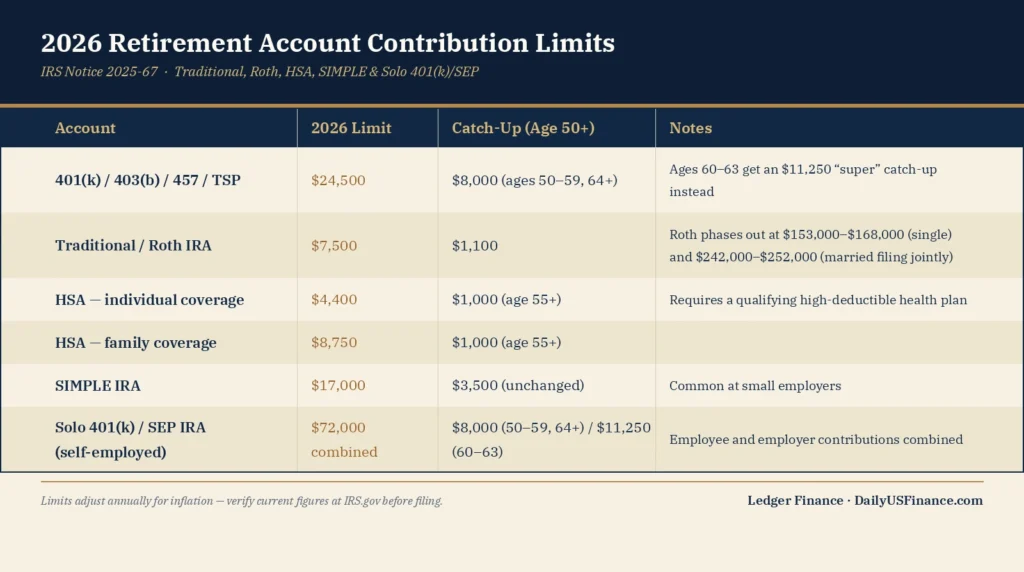
One 2026-specific wrinkle: under SECURE 2.0, workers 50 and older who earned more than $150,000 in the prior year must now make their catch-up contributions as after-tax Roth dollars if their employer’s plan offers a Roth option, rather than pre-tax. It doesn’t change the dollar limit, but it changes the tax treatment for higher earners.
How to Actually Start Retirement-Maxxing
Maxing every account at once usually isn’t realistic in year one. This order gets you the most value per dollar:
- Capture the full employer 401(k) match first. It’s an immediate, guaranteed return before any other consideration.
- Fund an HSA if you’re on a high-deductible health plan. It’s the only account with a triple tax advantage — pre-tax contributions, tax-free growth, and tax-free withdrawals for medical expenses.
- Max a Roth or traditional IRA next. IRAs typically offer more investment choice than a workplace plan, and Roth contributions can be withdrawn penalty-free if needed.
- Push 401(k) contributions toward the annual cap, ideally through automatic annual escalation (raising your rate by 1–2% each year) rather than one large jump.
- Redirect raises and bonuses before lifestyle creep absorbs them. Increasing your contribution rate alongside a raise, instead of after spending adjusts upward, is the single easiest way to reach the max without feeling it.
Can Self-Employed and Gig Workers Retirement-Max Too?
Yes — and self-employed workers actually have access to much higher limits than W-2 employees. A Solo 401(k) or SEP IRA lets you contribute as both “employee” and “employer,” and the combined 2026 cap across both roles is $72,000 (rising to $80,000 with catch-up for ages 50–59 and 64+, or $83,250 for ages 60–63).
The two account types reach that ceiling differently. A SEP IRA is funded entirely through the employer-side contribution, capped around 20% of net self-employment income for a sole proprietor. A Solo 401(k) adds an employee deferral on top (up to the same $24,500 used by W-2 workers) plus an employer contribution, which is why it usually allows a higher total at lower income levels — a sole proprietor earning $60,000 can typically contribute roughly $36,000 through a Solo 401(k) versus about $12,000 through a SEP IRA at the same income. Above roughly $175,000 in net self-employment income, the gap between the two largely disappears.
What Does Maxing Out Actually Save You?
This is the part most coverage skips. Here’s what retirement-maxxing looks like at different income levels.
The median U.S. worker earns about $62,608 a year, according to Bureau of Labor Statistics wage data. Fully maxing a $24,500 401(k) contribution at that income means setting aside nearly 39% of gross pay before tax — unrealistic for most single earners, which is why full maxing tends to cluster among higher earners or dual-income households:
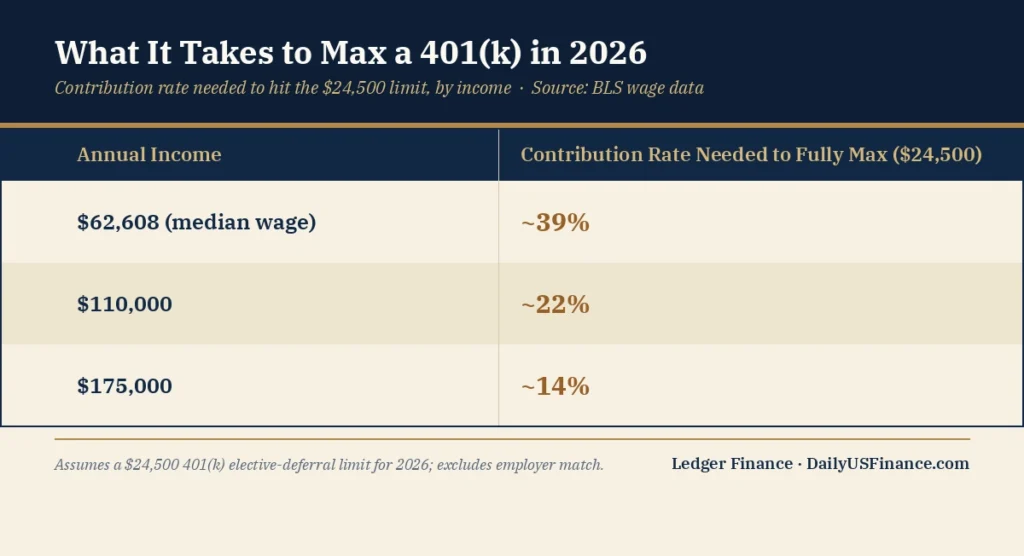
The tax savings are immediate. A $24,500 pre-tax 401(k) contribution for someone in the 22% federal marginal bracket reduces that year’s federal tax bill by roughly $5,390 — money that would otherwise go to the IRS, not toward retirement.
The growth math is where retirement-maxxing earns its name. If a 26-year-old contributed the full $24,500 every year (holding the limit flat, which understates reality since limits rise with inflation) until age 65, at a 7% average annual return, the account would grow to roughly $4.5 million. That figure is illustrative only — it ignores taxes on withdrawal, assumes an unbroken 39 years of full contributions, and isn’t a guarantee of future returns, but it illustrates why starting a decade earlier matters more than contributing a larger amount later.
Is Retirement-Maxxing Right for You?
- Money gets locked up. Standard 401(k) and traditional IRA withdrawals before age 59½ generally trigger a 10% penalty plus income tax, with limited exceptions. (Roth IRA contributions, not earnings, can be withdrawn penalty-free at any time.)
- It competes with other priorities. High-interest debt payoff and a 3–6 month emergency fund typically deserve attention before aggressive maxing, since an emergency that forces an early withdrawal can undo the tax benefit entirely.
- It can mean real lifestyle sacrifice. Bloomberg’s coverage of the trend features savers living with roommates, cooking at home, and driving old cars well into their late 20s to hit these numbers — a legitimate choice, but not a costless one, and burnout is a real risk if it’s not sustainable long-term.
- Opportunity cost is real. A dollar locked into a retirement account isn’t available for a home down payment, a business investment, or other medium-term goals.
“A reasonable middle ground: build the emergency fund, capture the full employer match, then scale contribution rates upward over a few years rather than jumping straight to the max.”
FAQ
What does retirement-maxxing mean?
Retirement-maxxing means contributing the IRS-allowed maximum to tax-advantaged retirement accounts — primarily a 401(k), IRA, and HSA — rather than contributing the employer match minimum or a smaller percentage of income.
How much can I contribute to a 401(k) in 2026?
The 2026 401(k) employee deferral limit is $24,500, or $32,500 if you’re 50 or older ($35,750 if you’re between 60 and 63, using the SECURE 2.0 “super” catch-up).
Should I retirement-max if I still have debt?
It depends on the debt. Most planners recommend capturing any employer 401(k) match first, then prioritizing high-interest debt (credit cards, personal loans) before pushing contributions toward the full annual max, since that interest rate usually exceeds realistic investment returns.
Can self-employed people retirement-max?
Yes. Self-employed workers can use a Solo 401(k) or SEP IRA, both capped at a combined $72,000 in 2026 — well above the $24,500 limit available to W-2 employees.
Is retirement-maxxing the same as FIRE?
They overlap but aren’t identical. FIRE (Financial Independence, Retire Early) generally targets retiring well before 59½ using taxable brokerage accounts for early access, while retirement-maxxing specifically means filling tax-advantaged accounts to their IRS limit, with money that’s typically locked up until traditional retirement age.
” Author: Allwin is the founder of Ledger Finance (DailyUSFinance.com), where he covers practical, data-driven guidance on saving, credit, and retirement planning for a U.S. audience.”
This article is for general informational purposes only and isn’t personalized financial, tax, or legal advice. Contribution limits, income thresholds, and tax rules shown above reflect 2026 figures and are subject to change — verify current numbers at IRS.gov or with a licensed financial advisor before making contribution decisions.
