“Most comparison articles stop at the headline rate. They’ll tell you a card offers “0% for 21 months” and move on to the next one, without ever showing what that actually costs once fees are included, whether you can realistically hit the payoff math, or whether you’d even get approved in the first place. This guide fills in those gaps: the real dollar cost of each type of offer, the qualification requirements issuers don’t put in the headline, and what to do if neither option is available to you.”
Balance Transfer Cards Compared: Who Actually Qualifies to Tackle Credit Card Debt at 0.99% vs. 0% APR
If you’re carrying credit card debt at today’s national average rate of roughly 21% APR, a balance transfer card can look like the obvious fix. But “0.99% intro APR” and “0% intro APR” aren’t the same offer, and the gap between them — plus who can actually get approved — determines whether a transfer saves you real money or just moves the debt around at a different rate for a while.
Most comparison articles stop at the headline rate. They’ll tell you a card offers “0% for 21 months” and move on to the next one, without ever showing what that actually costs once fees are included, whether you can realistically hit the payoff math, or whether you’d even get approved in the first place. This guide fills in those gaps: the real dollar cost of each type of offer, the qualification requirements issuers don’t put in the headline, and what to do if neither option is available to you.
What’s the Real Difference Between a 0.99% and a 0% Intro APR Balance Transfer Card?
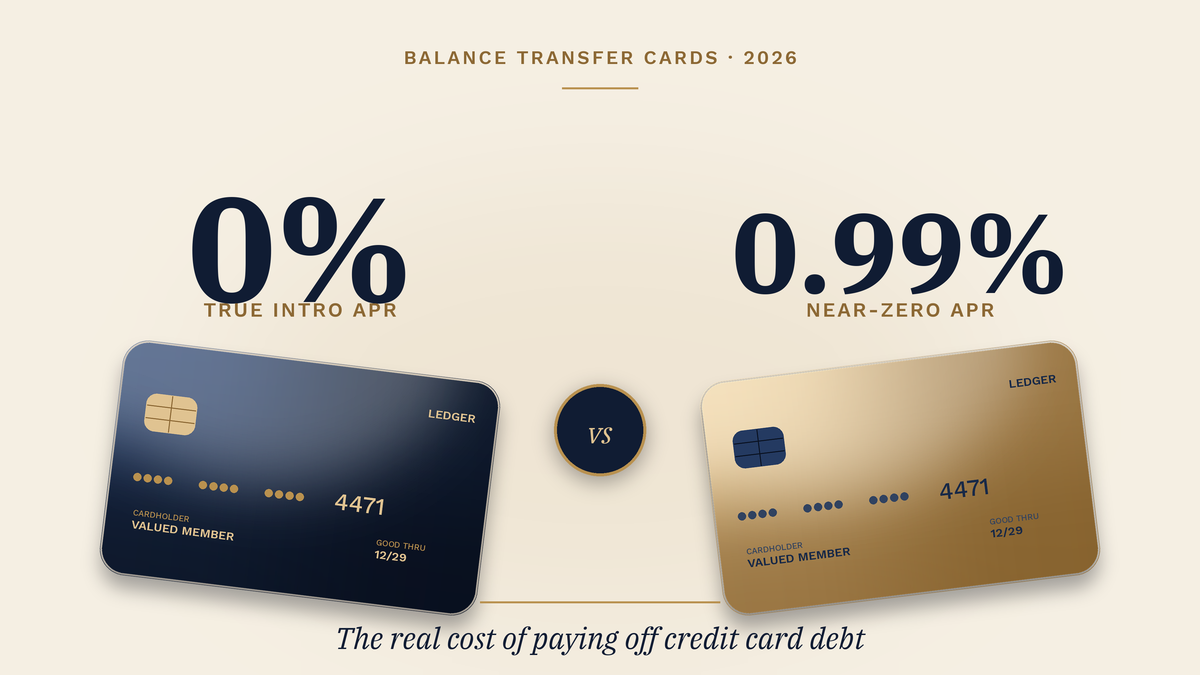
A 0.99% intro APR still charges a small amount of interest, while a true 0% offer charges none — but the 0.99% card often wins anyway because of a shorter runway, no transfer fee, and a lower rate if you don’t finish paying it off. The two structures show up from different types of issuers, and they trade off against each other in ways a headline rate doesn’t show.
The clearest example of a near-zero offer is the Navy Federal Credit Union Platinum Card, which gives eligible members 0.99% intro APR for 12 months on transfers made within 60 days of account opening, with no balance transfer fee at all. Compare that to three widely available 0% cards:
- Wells Fargo Reflect® — 0% intro APR for 21 months on purchases and qualifying transfers (posted within 120 days), then 17.49%–28.24% variable APR; balance transfer fee of 5% (minimum $5)
- Citi® Diamond Preferred® — 0% intro APR for 21 months on balance transfers and 12 months on purchases, then 16.49%–27.24% variable APR; transfer fee of 3% (minimum $5) if completed within the first 4 months, 5% after that
- Chase Slate® — 0% intro APR for 21 months on purchases and transfers, then 18.24%–28.24% variable APR; transfer fee of $5 or 5%, whichever is greater (this card relaunched in early 2026 and replaced the Chase Slate Edge, which stopped accepting new applicants)
On a $9,233 balance, the fee alone on the 5% cards runs about $462 — money you pay on day one regardless of how fast you pay off the balance. The 0.99% Navy Federal offer skips that fee entirely, and on the same balance paid down evenly over 12 months, the actual interest cost works out to roughly $45–$50 total. So the “not-quite-0%” card can end up cheaper than a “true 0%” card once you count the transfer fee — the intro rate alone doesn’t tell you the real cost.
Click Here for: Credit Card Debt Forgiveness in 2026: How It Truly Works
How Much Do You Actually Need to Pay Each Month to Clear the Balance in Time?
Divide your transferred balance by the number of months in the intro period — that’s your break-even monthly payment. Miss it, and whatever’s left when the intro period ends starts accruing interest at the card’s regular ongoing rate, not the promotional one.
On a $9,233 balance:
- A 12-month intro window (like Navy Federal’s) requires about $770/month to hit zero before the promo rate expires
- A 21-month intro window (like Reflect, Diamond Preferred, or Slate) requires about $440/month
That’s the trade-off in plain terms: the shorter 0.99% offer forces a much bigger monthly commitment, while the longer 0% offers give you nearly double the time but cost more upfront in transfer fees. If $770 a month isn’t realistic, the math tips firmly toward the 21-month cards even with their higher fees, because a leftover balance hitting Wells Fargo Reflect’s up-to-28.24% or Chase Slate’s up-to-28.24% ongoing APR is far more expensive than Navy Federal’s ongoing 10.24%–18% range. Whatever card you choose, run this division first — it’s the single number that tells you whether the offer actually fits your budget.
What Credit Score Do You Need to Qualify — and How Does the Application Actually Work?
Most of these cards require good to excellent credit, generally in the 670–700+ range, and you can usually check your odds with a soft credit pull before applying. A soft pull doesn’t affect your credit score; the formal application that follows does, through a hard inquiry.
Citi and several other major issuers offer online pre-qualification tools that use a soft pull to estimate your approval odds and likely terms before you formally apply
Wells Fargo Reflect doesn’t publish an official minimum score, but approvals cluster among applicants with good to excellent credit
Chase’s Slate card is generally recommended for applicants around 700+
Navy Federal has an extra gate before credit even enters the picture: you have to be eligible for membership. That means active duty or veteran status in any branch, Department of Defense civilian employment, or an immediate family or household connection to someone who qualifies — plus a $5 minimum deposit to open the membership itself
If you’re not NFCU-eligible, that card is off the table regardless of your credit score, which is exactly the kind of qualification detail that’s easy to miss when a headline rate looks unbeatable.
It’s also worth understanding what each type of check actually does to your score. A soft pull, used for pre-qualification, has no impact and won’t show up to other lenders. The hard inquiry that comes with a formal application typically costs a small number of points and stays on your report for about two years, though its effect on your score usually fades well before then. Applying to two or three cards in a short window compounds that dip, so it’s worth pre-qualifying wherever the issuer offers it and only formally applying to the card you’re actually likely to get.
Click Here for: What Is Moneymaxxing? The Smart 2026 Money Trend
Should You Close the Old Card After You Transfer the Balance?
No — in most cases, keep it open and unused. Closing a paid-off card removes that available credit from your total limit, which raises your credit utilization ratio, and it can shorten your average account age over time, both of which are meaningful factors in your credit score.
A few practical notes:
- If the old card has an annual fee you can’t justify anymore, ask the issuer to downgrade it to a no-fee version instead of closing it outright
- Most issuers won’t let you transfer a balance between two cards they issue — a Citi balance generally can’t move to another Citi card, and the same pattern holds at Chase and Wells Fargo, so double-check this before you apply for a transfer card from a bank you already carry a balance with
- Keeping the old account open costs nothing as long as you’re not tempted to run up a new balance on it
What If You Don’t Qualify for a Balance Transfer Card at All?
If your credit isn’t strong enough for a 0% or near-0% card, you have two realistic paths: a debt consolidation personal loan, or nonprofit credit counseling through a Debt Management Plan. Neither requires the credit score a promotional balance transfer card does.
Debt consolidation loans carry a national average rate around 12% as of mid-2026, with the best-qualified borrowers seeing rates closer to 6–7%. If your current cards are charging near the 21% national average, even a mid-tier personal loan rate can meaningfully cut your interest cost — just factor in the origination fee, typically 1–6% of the loan amount
Nonprofit credit counseling, through a National Foundation for Credit Counseling (NFCC) member agency, starts with a free financial review. If a Debt Management Plan makes sense, the counselor negotiates directly with your creditors, often reducing or waiving finance charges, and you make one consolidated monthly payment instead of juggling several
Neither option requires a hard credit pull just to explore — the initial NFCC counseling session is free, and most personal loan lenders offer rate pre-qualification with a soft pull, the same way credit card issuers do.
Rates, fees, and intro APR periods change with issuer promotions and Federal Reserve rate movements, so confirm current terms directly on the issuer’s site before applying — the figures above reflect published terms as of mid-2026.
“The mistake I see most often isn’t picking the wrong card — it’s picking a card without doing the division first. If the monthly payment the intro period requires doesn’t fit the budget, the 0% offer turns into a countdown clock instead of a solution.”
FAQ
Is 0.99% APR actually better than 0% APR on a balance transfer card?
It can be, once you account for balance transfer fees. A 0.99% card with no transfer fee can cost less overall than a 0% card charging a 3–5% fee, especially if the 0.99% card also carries a lower ongoing rate for any balance you don’t pay off in time.
How long do 0% intro APR balance transfer offers typically last in 2026?
Most run 12 to 21 months, with the longest current offers — including Wells Fargo Reflect, Citi Diamond Preferred, and Chase Slate — extending to 21 months on qualifying transfers.
Does applying for a balance transfer card hurt my credit score?
Pre-qualification tools use a soft credit pull, which doesn’t affect your score. The formal application triggers a hard inquiry, which typically causes a small, temporary dip.
What happens if I don’t pay off my balance transfer before the intro period ends?
Any remaining balance starts accruing interest at the card’s regular ongoing variable APR, which on the cards discussed here ranges from about 10.24% up to 28.24% depending on the issuer and your creditworthiness.
Can I transfer a balance to another card from the same bank?
Usually not. Most issuers, including Citi, Chase, and Wells Fargo, don’t allow balance transfers between two cards they issue, so a transfer card needs to come from a different bank than the one you currently owe.
Author Bio:
Allwin is the founder of DailyUSFinance.com, where he covers credit, banking, and everyday personal finance for U.S. readers — including immigrants and visa holders navigating the American financial system for the first time.
- Trump Account vs. 529 Plan: Which Wins in 2026?
 In this article Trump Account vs. 529 Plan: Which Should You Use in 2026? What Is a Trump Account, and How…
 - Retirement-Maxxing: Best Way to Max Your 401(k) in 2026In this article Retirement-Maxxing: What It Is and How to Max Out Your 401(k) in 2026 What Is Retirement-Maxxing? Why Is…
- Trump Accounts for Kids: Complete 2026 Parent GuideIn this article Trump Accounts Explained: Complete 2026 Parent's Guide Where Things Actually Stand as of August 2026 Who Qualifies for…
- Trump Account Employer Match: Real Tax Savings 2026In this article Trump Account Employer Match 2026: Real Tax Savings by Income What Is the Trump Account Employer Match, Exactly?…
- Credit Card Debt: Compare 0.99% vs 0% APR CardsIn this article Balance Transfer Cards Compared: Who Actually Qualifies to Tackle Credit Card Debt at 0.99% vs. 0% APR What's…