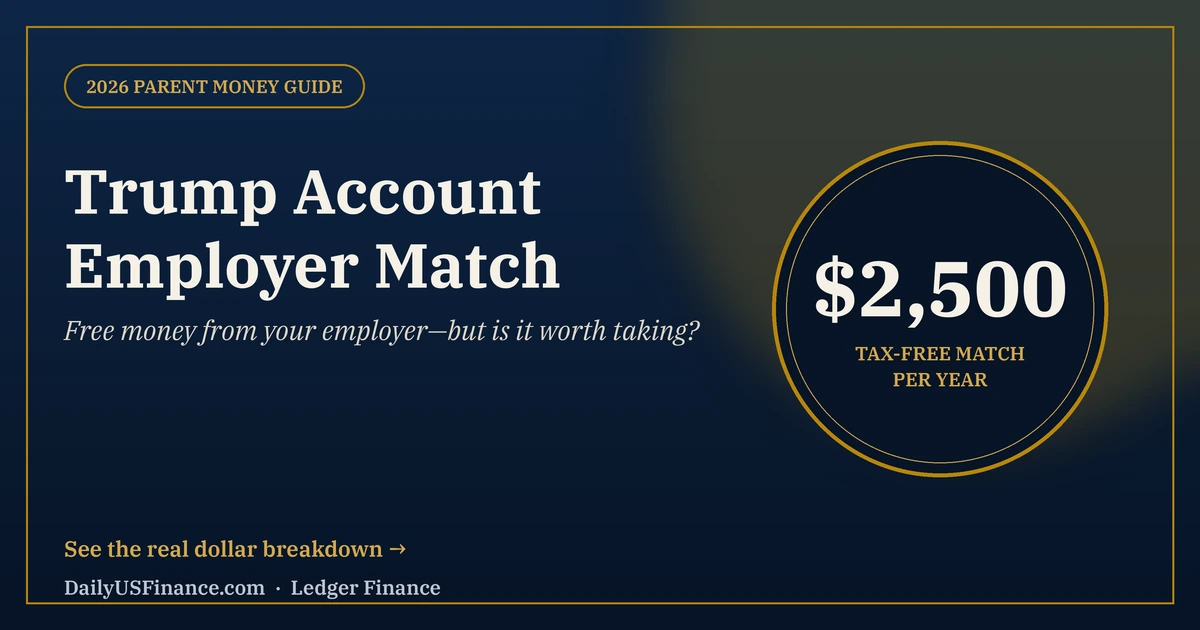
“Quick Answer: A Trump Account employer match is worth up to $2,500 per year, tax-free — the same flat value for every family, regardless of income. If you also route your own contribution pre-tax through your employer’s cafeteria plan, the tax savings on that portion scale with your bracket: roughly $300 at the 12% rate, $600 at 24%, and $875 at 35% on a $2,500 contribution. As of August 2026, an estimated 50–60+ major employers offer the match, though the pre-tax payroll rule is still a proposed Treasury/IRS regulation, with a public hearing scheduled for October 13, 2026 before it can be finalized.”
See how much a Trump Account employer match is worth by income, plus 529 comparisons, immigrant-family rules, and withdrawal tax rules for 2026.
Trump Account Employer Match 2026: Real Tax Savings by Income
If your employer offers a Trump Account employer match, it’s one of the few genuinely free-money benefits left in a workplace benefits package — but how much it’s actually worth depends heavily on your household’s tax bracket, and almost no coverage of this topic does that math for you. This guide breaks down exactly what the match is worth at different income levels, how it stacks up against a 529 or custodial Roth IRA, what it means for immigrant and mixed-status families, and how the money gets taxed when your child eventually withdraws it.
A quick note on timing: as of August 2026, the pre-tax payroll piece of this benefit is still a proposed Treasury/IRS regulation, not a finalized rule. A public hearing is scheduled for October 13, 2026, before it can be finalized — so treat the mechanics below as the current best understanding, and check Treasury’s guidance page before making decisions tied to a specific tax year.
What Is the Trump Account Employer Match, Exactly?
A Trump Account (officially a Section 530A account) is a custodial, IRA-style savings account for children under 18, created under the 2025 tax law. Every child born 2025–2028 with a Social Security number can receive a one-time $1,000 government deposit, and parents, grandparents, or others can contribute up to $5,000 per year until the year before the child turns 18.
As of August 2026, Treasury guidance opened two new funding channels on top of that:
- Employer contributions: Employers can contribute up to $2,500 per employee per year, tax-free, directly to that employee’s dependent’s Trump Account. This money doesn’t show up as W-2 income.
- Employee pre-tax payroll contributions: Employees can now route their own contributions through an employer cafeteria plan pre-tax, similar to how an FSA or HSA works.
- Both the employer’s $2,500 and your own contribution count toward the same $5,000 annual household cap — they are not separate buckets.
How Much Is the Match Actually Worth at Your Income?
The employer’s $2,500 contribution is worth exactly $2,500 to every family, regardless of income — it’s simply free money that isn’t taxed as W-2 wages. What changes by bracket is the value of your own pre-tax payroll contribution, because that value comes from the federal tax you avoid paying on it.

Trump Account vs. 529 vs. Custodial Roth IRA: Which Should You Use First?
If your employer offers a match, take it first — it’s the only “free money” option on this list. After that, which account you fund next depends on your goal.
- Trump Account: No income limits, no earned-income requirement for the child, funds can be used for anything (not just education) after age 18. Growth is tax-deferred, but withdrawals are taxed as ordinary income, similar to a traditional IRA.
- 529 plan: Best for education specifically — qualified withdrawals for tuition and related expenses are completely tax-free, which a Trump Account can’t match.
- Custodial Roth IRA: Requires the child to have earned income, but qualified withdrawals in retirement are tax-free — the opposite tax treatment of a Trump Account.
- UTMA/UGMA: No restrictions on use and no special tax treatment, but the child gains full, unrestricted control of the account at the state’s age of majority (often 18–21), with no ability to delay that handoff the way some other accounts allow.
- A reasonable priority order for most families: employer match first, then a 529 if college is the specific goal, then additional Trump Account or custodial Roth contributions depending on whether you want flexibility (Trump Account) or tax-free growth tied to earned income (Roth).
Are Immigrant and Mixed-Status Families Eligible?
Yes, in most cases — but the requirements apply to the child, not the parent. To receive the $1,000 government pilot deposit, the child must be a U.S. citizen, have a valid SSN, and be born between January 1, 2025 and December 31, 2028.
Here’s what matters most for mixed-status households:
- The parent or guardian opening the account does not need to be a U.S. citizen or have an SSN — an ITIN is sufficient for the adult filing the election.
- Order of priority for who can open the account: legal guardian, then parent, then adult sibling, then grandparent.
- A child with only an ITIN does not qualify — the child specifically needs a valid SSN, though a child whose status changes can apply once they receive an updated Social Security card.
- Some undocumented families have hesitated to apply due to privacy concerns about submitting information through federal systems — that’s a legitimate consideration to weigh, not a reason the account itself is unavailable to you.
“CLick Here For: Is the Trump Account App Legit? 2026 Guide & Scam Alert“
How to Ask Your Employer for a Trump Account Match
Only a small share of employers currently offer this — one April 2026 poll found just 4% of companies planned to implement a program. If yours doesn’t, here’s a simple way to raise it:
- Check your benefits portal or ask HR directly whether a Trump Account contribution program exists — some companies have adopted it quietly without a wide internal announcement.
- Point them to Treasury’s employer guidance (home.treasury.gov) — benefits teams often need this framed as a low-cost, low-liability benefit, since the Department of Labor has confirmed these programs generally fall outside ERISA.
- Frame it as a retention benefit, not a request for a raise — companies matching this benefit are typically doing it to compete for talent, not out of obligation.
- Ask about timing — since the pre-tax payroll rule is still proposed, many employers are waiting for final regulations before building payroll systems to support it.
What If You’re Self-Employed or a 1099 Contractor?
The pre-tax payroll lane and the employer match both require a traditional W-2 employer running a cafeteria plan — so if you’re self-employed, freelance, or work as a 1099 contractor, neither is directly available to you. You can still open a Trump Account for your child and contribute up to the $5,000 annual cap, but those contributions would be after-tax, the same as a grandparent or any other contributor.
If you run your own S-corp and pay yourself a W-2 salary through it, there may be a path to structuring an employer contribution for yourself, but this hasn’t been directly addressed in Treasury’s guidance yet — talk to a tax professional before attempting it.
How Is the Money Taxed When Your Child Withdraws It?
No withdrawals are allowed before the calendar year your child turns 18. At that point, the account automatically converts into a traditional IRA the child controls, and standard IRA withdrawal rules apply from there.
- Withdrawals are taxed as ordinary income, and a 10% early withdrawal penalty applies until age 59½ — unless an exception applies (first-time home purchase up to $10,000, qualified education expenses, disability, and a few others).
- Because the government’s $1,000 seed deposit and any employer contributions don’t create “basis,” that money — along with all investment growth — is fully taxable on withdrawal. Only the family’s own after-tax contributions avoid being taxed again.
- Your child can also choose to convert the account to a Roth IRA after 18, paying ordinary income tax on the taxable portion up front in exchange for tax-free growth and withdrawals later.
If the money is specifically earmarked for college, a 529 plan remains more tax-efficient for that one purpose, since qualified 529 withdrawals are entirely tax-free.
Bottom Line
The Trump Account employer match is worth taking if it’s offered — $2,500 in truly free money doesn’t come around often in a benefits package. But because the pre-tax payroll rule is still a proposed regulation (with a public hearing set for October 13, 2026) and even basic figures like the number of participating employers vary between sources — Treasury cites roughly 50 companies, while some benefits consultants cite 60+ — treat any specific numbers you read, including the ones in this article, as a snapshot, and confirm current details directly with Treasury before making decisions for a specific tax year.
FAQ
Does the employer’s Trump Account contribution count as taxable income to me?
No. Up to $2,500 per year in employer contributions to your dependent’s Trump Account is excluded from your gross income and does not appear as W-2 wages.
Does my employer’s Trump Account match count toward the $5,000 annual limit?
Yes. Both the employer’s contribution and any pre-tax amount you contribute yourself count toward the same $5,000-per-year cap on the account.
Can I open a Trump Account if I’m undocumented but my child is a U.S. citizen?
Generally yes. Eligibility for the $1,000 pilot deposit is based on the child’s citizenship, SSN, and birth year — not the parent’s immigration status. The adult opening the account can use an ITIN instead of an SSN.
Is the Trump Account employer match a permanent rule?
Not yet. As of August 2026, the pre-tax payroll contribution piece is a proposed Treasury/IRS regulation, with a public comment hearing scheduled for October 13, 2026, before it can be finalized.
What happens to the money if my child never withdraws it before age 18?
Nothing changes automatically before then — no withdrawals are permitted before the calendar year the child turns 18. At that point the account converts into a traditional IRA under the child’s control.
Author Bio
Written by Allwin, founder of DailyUSFinance.com, where he covers credit, debt, and financial-planning topics for U.S. families — including immigrant and mixed-status households navigating the U.S. financial system.
- Trump Account vs. 529 Plan: Which Wins in 2026?
 In this article Trump Account vs. 529 Plan: Which Should You Use in 2026? What Is a Trump Account, and How…
 - Retirement-Maxxing: Best Way to Max Your 401(k) in 2026In this article Retirement-Maxxing: What It Is and How to Max Out Your 401(k) in 2026 What Is Retirement-Maxxing? Why Is…
- Trump Accounts for Kids: Complete 2026 Parent GuideIn this article Trump Accounts Explained: Complete 2026 Parent's Guide Where Things Actually Stand as of August 2026 Who Qualifies for…
- Trump Account Employer Match: Real Tax Savings 2026In this article Trump Account Employer Match 2026: Real Tax Savings by Income What Is the Trump Account Employer Match, Exactly?…
- Credit Card Debt: Compare 0.99% vs 0% APR CardsIn this article Balance Transfer Cards Compared: Who Actually Qualifies to Tackle Credit Card Debt at 0.99% vs. 0% APR What's…