“Quick Answer: For pure college savings, the 529 plan wins — withdrawals for qualified education costs are completely tax-free, and most states add a tax deduction on top. The Trump Account wins on flexibility: it comes with a free $1,000 federal seed deposit and isn’t restricted to education, but its growth is only tax-deferred (taxed as ordinary income later), not tax-free like a 529. Most families should use both, not choose one.”
Trump Account vs. 529 plan: real dollar math, tax rules, and a clear framework to decide which savings account is right for your child in 2026.
Trump Account vs. 529 Plan: Which Should You Use in 2026?
If you’re trying to decide between a Trump Account and a 529 plan, the short answer is this: a 529 plan is almost always the stronger choice for pure college savings, because qualified withdrawals come out completely tax-free. A Trump Account is better thought of as a bonus, government-seeded head start on long-term wealth that happens to also work for education — but the money is taxed as ordinary income when it comes out, which changes the math more than most articles admit.
This guide walks through the real numbers for two different income levels, explains exactly how each account is taxed, and covers the parts of this decision that generic explainers skip: immigrant and mixed-status families, self-employed parents, and how to actually get your employer to chip in.
This article reflects federal rules as of August 2026. Trump Account rules are new, several details remain proposed, and figures such as contribution limits are indexed for inflation starting in 2027 — always confirm current numbers at trumpaccounts.gov, irs.gov, or with a CPA before you act. This is educational content, not personalized financial or tax advice.
What Is a Trump Account, and How Is It Different From a 529 Plan?
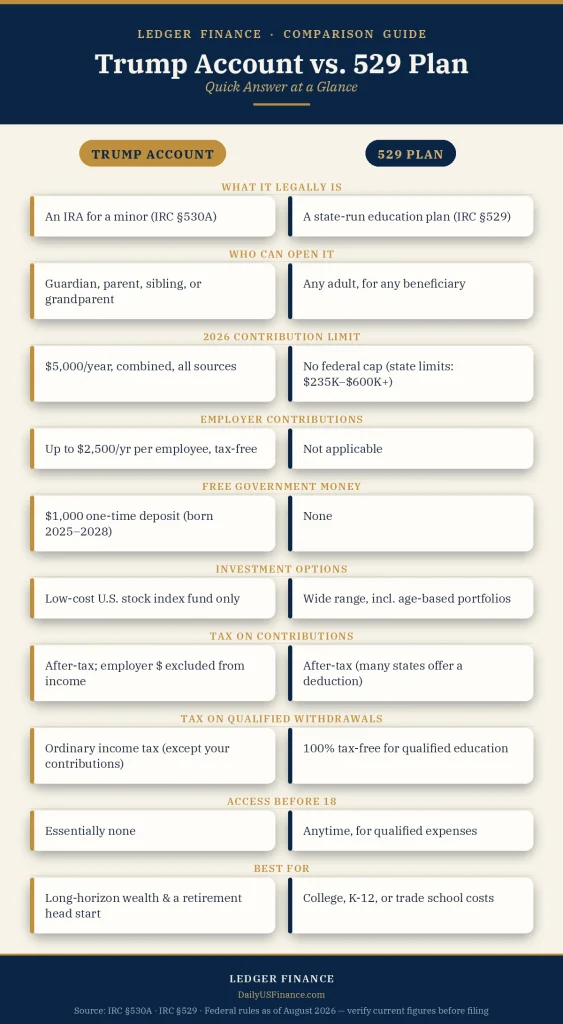
A Trump Account is a new type of individual retirement account created for children by the One Big Beautiful Bill Act (OBBBA), with the first accounts opening on July 4, 2026. A 529 plan is a state-sponsored education savings plan that has existed for decades — the two were built for different purposes and taxed under completely different rules.
The core distinction: a Trump Account is legally an IRA, so it follows IRA-style tax-deferred, taxed-on-the-way-out treatment. A 529 plan is an education account, so it follows tax-free-in-and-out treatment as long as the money is spent on qualifying expenses. That single difference drives almost every other comparison in this article.
A few structural facts worth knowing upfront:
- Trump Accounts require the child to have a Social Security number and be under 18.
- Contributions to a Trump Account are invested by law in low-cost funds that track a broad U.S. stock index, such as the S&P 500 — you don’t get to pick individual stocks or bonds.
- 529 plans, by contrast, typically offer age-based portfolios that automatically shift from stocks to bonds as college approaches, plus static portfolio options.
- You cannot roll money directly between a Trump Account and a 529 plan in either direction — they’re governed by different sections of the tax code with no transfer mechanism between them.
- Nothing stops you from funding both accounts for the same child at the same time.
The Real Numbers: What Would Each Account Actually Be Worth by Age 18?
Quick answer: For a family contributing the same amount to both accounts and using the money for college, the 529 plan usually comes out ahead in after-tax terms — even though the Trump Account gets a free $1,000 head start — because the 529’s tax-free withdrawal beats the Trump Account’s ordinary-income tax bill.
Here’s the math, using two illustrative households. Both examples assume a 7% average annual return (a commonly used long-term stock market assumption — actual returns are never guaranteed and will vary year to year), contributions starting at birth in 2026, and use of the money for the child’s college costs at age 18.
Family Earning $75,000 (12% Federal Bracket)
With the 2026 standard deduction of $32,200 for married couples, a household earning $75,000 has roughly $42,800 in taxable income — squarely inside the 12% federal bracket. This family contributes $2,000/year to whichever account they choose.
Trump Account:
- $1,000 federal pilot deposit at birth, growing to about $3,380 by age 18
- $2,000/year in parent contributions, growing to about $67,998 by age 18
- Total balance at 18: roughly $71,400
- Only the parents’ own contributions ($36,000) count as tax-free “basis” — the $1,000 seed and all investment growth are taxed as ordinary income when withdrawn
- Taxable portion: about $35,400. At a 12% rate (assuming the now-adult child is in a low bracket as a student), that’s roughly $4,248 in tax
- Net after-tax value: about $67,152
529 Plan:
- Same $2,000/year contribution, growing to about $67,998 by age 18 (no seed money)
- Withdrawn for qualified education expenses: 100% tax-free
- Net after-tax value: $67,998
For this family, the 529 plan nets out roughly $850 ahead of the Trump Account, despite the Trump Account’s free $1,000 kickstart — the ordinary-income tax bite on withdrawal outweighs the free seed money in this scenario. If the child ends up in a higher bracket when they withdraw, or the money isn’t used for education (where the 10% penalty is waived but income tax still applies), the gap widens further in the 529’s favor.
Family Earning $250,000 (24% Federal Bracket)
At $250,000 household income, taxable income is roughly $217,800 after the standard deduction — just into the 24% federal bracket. This family has access to an employer that offers a Trump Account benefit under Section 128, so they combine a $2,500/year employer contribution with a $2,500/year contribution of their own to hit the full $5,000 annual cap.
Trump Account:
- $5,000/year combined contributions, growing to about $169,995 by age 18
- $1,000 seed growing to about $3,380
- Total balance at 18: roughly $173,400
- Only the parent’s own $2,500/year ($45,000 total) counts as basis — the employer’s contributions and the $1,000 seed do not
- Taxable portion: about $128,400. At a 12% withdrawal-year rate, that’s roughly $15,408 in tax
- Net after-tax value: about $157,992
- Separately, the employer’s $2,500/year contribution was excluded from the parent’s taxable income during the working years — at a 24% marginal rate, that’s about $600/year, or roughly $10,800 in real, immediate federal tax savings over 18 years, money the family keeps regardless of what happens to the account balance later
529 Plan:
- $5,000/year contribution, growing to about $169,995 by age 18 (well under the $19,000/$38,000 2026 gift tax exclusion, so no gift tax filing required)
- Withdrawn for qualified education expenses: 100% tax-free
- Net after-tax value: $169,995
- Many states also offer a state income tax deduction for 529 contributions — check your specific state, since deduction caps range from around $500 to unlimited
Even with the employer’s pre-tax perk baked in, the 529 still nets out roughly $12,000 ahead for pure education use. But the family also pocketed nearly $11,000 in real tax savings during the accumulation years just from the employer benefit — money that’s separate from either account balance and can be invested elsewhere. That upfront tax savings, not the eventual account balance, is the real argument for taking advantage of an employer Trump Account program if one is offered.
How Is the Money Taxed When It Comes Out?
Quick answer: After the child turns 18, a Trump Account automatically converts to a traditional IRA. From that point, only your own after-tax contributions come out tax-free — everything else (the $1,000 seed, any employer or government money, and all investment growth) is taxed as ordinary income, plus a 10% early-withdrawal penalty unless an exception applies.
This is the single most misunderstood piece of the Trump Account, and it’s the reason the dollar math above matters more than the headline “$1,000 free for every kid” framing suggests.
- Contributions: Not tax-deductible for individuals. Employer contributions (up to $2,500/year) are excluded from the worker’s taxable income.
- Growth: Tax-deferred while the child is under 18 — no annual tax on gains.
- Withdrawals after 18: The account becomes a traditional IRA. The taxable portion is taxed at the account owner’s (the now-adult child’s) ordinary income rate — even gains that would otherwise qualify for lower long-term capital gains rates outside the account.
- Penalty: A 10% early-withdrawal penalty applies before age 59½, with standard IRA exceptions carved out, including qualified higher education expenses, up to $10,000 for a first-time home purchase, and certain medical costs.
- Roth conversion option: After 18, the owner can convert the account to a Roth IRA, paying ordinary income tax on the pre-tax portion now in exchange for tax-free growth and withdrawals later — often most efficient in a year when the young adult’s income (and tax bracket) is lowest, such as a gap year or the first year or two of college.
As Susan Bart, an estate planning attorney who spoke on a Trump Accounts panel hosted by the American College of Trust and Estate Counsel, has explained, most of what comes out of a Trump Account will be taxed at the beneficiary’s ordinary income rate — even the portion that grew as capital gains inside the account. That’s a meaningfully different outcome than a 529 plan, where qualified withdrawals — contributions and all the growth — are never taxed at the federal level.
Trump Account vs. 529 vs. Roth IRA for Kids vs. UTMA/UGMA: Which Wins for What Goal?
CLICK HERE FOR: “Trump Accounts for Kids: Complete 2026 Parent Guide”
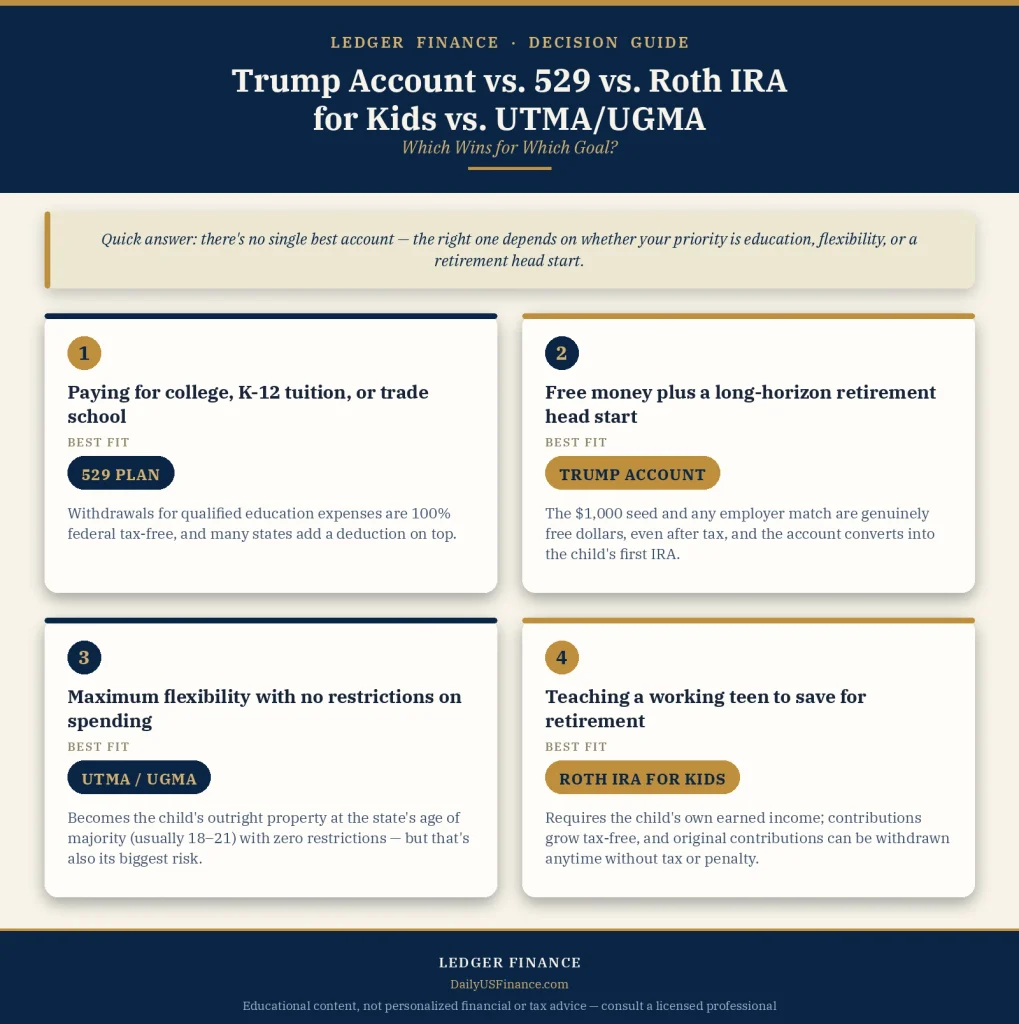
Quick answer: There’s no single best account — the right one depends on whether your priority is education, flexibility, or a retirement head start.
A few things worth knowing about the two accounts that rarely get compared to Trump Accounts directly:
- UTMA/UGMA accounts have no contribution limit beyond standard gift tax rules, but they carry two real downsides: the “kiddie tax” can tax a child’s unearned investment income at the parent’s higher rate above an annual threshold, and — critically for college-bound families — the balance counts as the student’s asset on the FAFSA, which is assessed far more heavily against financial aid eligibility than a parent-owned 529 or Trump Account.
- Roth IRAs for kids only work if the child has real earned income (a job, self-employment, or 1099 income), because contributions can’t exceed what they actually earned that year, up to the standard annual IRA limit.
- A Trump Account and a 529 plan can be funded for the same child simultaneously with no conflict — many financial firms, including Fidelity and J.P. Morgan, are now explicitly framing this as a “fund both” decision rather than an either/or.
What If Your Family Has ITIN Filers or a Mixed Immigration Status?
Quick answer: The child needs a valid Social Security number — an ITIN does not work for the child. But the adult opening the account on the child’s behalf can generally use their own ITIN if they don’t have an SSN.
This distinction gets lost in most coverage of Trump Accounts, and it matters a lot for mixed-status households:
- To open a Trump Account, the beneficiary (the child) must have a valid SSN and be under 18. An ITIN does not satisfy this requirement for the child.
- The adult opening the account — a parent, legal guardian, adult sibling, or grandparent, in that priority order — does not need to be a U.S. citizen or have an SSN themselves. They can generally complete the application using their own ITIN.
- A U.S.-born child of parents on a work visa, or a child in a green-card household, typically has both citizenship and an SSN and should qualify for the account itself.
- The separate $1,000 federal pilot deposit appears to carry an additional citizenship requirement on top of the SSN and 2025–2028 birth-year window, based on several sources covering the program. Because reporting on this specific point has varied, confirm your child’s eligibility for the $1,000 directly at trumpaccounts.gov or with a tax professional before assuming it applies.
- If your child doesn’t currently have an SSN — for example, a child born abroad to a U.S. citizen parent — that’s the first step to sort out before an account can be opened.
Can Self-Employed and Gig Workers Use a Trump Account?
Quick answer: Yes, as an individual — sole proprietors, freelancers, and 1099 contractors can contribute up to the same $5,000/year after-tax limit as anyone else. What they generally can’t do is give themselves the $2,500/year employer pre-tax benefit, even if they run their own business.
Proposed IRS regulations released in August 2026 define “employee” for the employer-contribution program using the standard common-law test, and specifically exclude sole proprietors, partners in a partnership, and more-than-2% S-corporation shareholders — even if that owner pays themselves a W-2 salary. Family attribution rules also mean a spouse or teenager on the payroll of a more-than-2% S-corp owner is typically treated the same way and is equally excluded.
Here’s what that means in practice for freelancers and gig workers:
- You can absolutely open a Trump Account for your child and contribute up to $5,000/year in after-tax dollars — same as any parent.
- If your business has actual W-2 employees (not you), you can sponsor a Trump Account contribution program that gives those employees the $2,500/year pre-tax benefit — you just can’t extend it to yourself as the owner.
- Because gig income fluctuates, automating a modest monthly contribution tends to work better than trying to fund the full annual limit in one lump sum.
- Many self-employed parents balance Trump Account contributions against their own retirement accounts, such as a SEP IRA or Solo 401(k), rather than treating the Trump Account as a substitute for their own retirement savings.
How Do You Get Your Employer to Offer Trump Account Contributions?
Quick answer: Ask HR directly, reference the Treasury’s August 2026 proposed regulations for structuring the benefit, and time the request around your company’s next open enrollment or benefits review cycle — most employers haven’t set this up yet, but the rules just got significantly easier to follow.
Adoption so far has been slow. A Mercer poll of nearly 350 U.S. employers taken in April 2026 found that only about 4% expected to implement a Trump Account contribution program in 2026 or 2027, with roughly two-thirds saying they’d decided against it.
That’s likely to shift: Treasury and the IRS released proposed regulations on August 10–11, 2026, that clarify exactly how employers can structure the benefit, and a public hearing on the proposal is scheduled for October 15, 2026 (written comments were due September 25; requests to speak at the hearing were due October 13).
According to Aon partner Melissa Elbert, employers now have much clearer administrative guidance than they did earlier in 2026, and interest is expected to grow as a result of the new rules.
If your employer hasn’t set this up, here’s a practical way to raise it:
- Find the right owner. This usually sits with HR/Total Rewards or whoever manages your Section 125 cafeteria plan (the same team that handles your FSA or dependent-care account).
- Name the mechanism, not just the idea. Ask specifically about a Section 125 cafeteria plan option for pre-tax Trump Account contributions under IRC §128 — this is a defined, low-cost benefit design, not a vague request.
- Point them to the August 2026 guidance. The new proposed Treasury regulations are specifically what removed much of the earlier uncertainty employers cited for not adopting this benefit.
- Note the low cost and easy sell. The employer’s $2,500/year contribution is a tax-deductible business expense and isn’t included in the employee’s taxable wages — it’s structurally similar to how many employers already think about HSA or 401(k) matching contributions.
- Time it to your benefits calendar. Most employers finalize new benefit offerings during open enrollment planning, typically several months in advance — raising this early gives HR time to build it into the next cycle.
So, Trump Account vs. 529: Which Should You Actually Use?
If you can only pick one and your goal is paying for college, choose the 529 plan — the tax-free withdrawal on qualified education expenses is difficult for a Trump Account to beat, even accounting for the free $1,000 seed money.
If you can fund more than one account, treat the Trump Account as a supplement rather than a replacement: claim the free $1,000 if your child qualifies, take full advantage of any employer pre-tax match if one is offered, and think of the account as an early foundation for retirement savings rather than a college fund. For most families with the means to save for both, funding a 529 first up to your realistic college-cost target, then directing extra savings — especially any employer-matched dollars — into a Trump Account, captures the strongest features of each account without giving up the tax-free education benefit that the 529 alone provides.
Frequently Asked Questions
Can I have a Trump Account and a 529 plan for the same child?
Yes. The two accounts are governed by different sections of the tax code, have separate contribution limits, and can be funded for the same child at the same time with no conflict.
Is Trump Account money taxed the same way as a 529 plan when it’s withdrawn?
No. Qualified 529 withdrawals for education are completely tax-free at the federal level. Trump Account withdrawals are taxed as ordinary income on everything except your own after-tax contributions, because the account legally converts into a traditional IRA at age 18.
Can I roll over a 529 plan into a Trump Account, or a Trump Account into a 529?
No. There is currently no mechanism to transfer funds directly between a Trump Account and a 529 plan in either direction — they operate under separate sections of the tax code.
Does my child need a Social Security number to open a Trump Account?
Yes, the child (the account beneficiary) must have a valid Social Security number — an ITIN does not qualify. The adult opening the account on the child’s behalf, however, can generally use their own ITIN if they don’t have an SSN.
How can self-employed parents contribute to a Trump Account?
Self-employed parents can contribute individually, in after-tax dollars, up to the standard $5,000/year combined limit — same as any other parent. They generally cannot access the $2,500/year employer pre-tax contribution benefit for themselves as business owners, though they can offer it to their own W-2 employees.
“Author Bio
Allwin is the founder of Sunviz Consultant and the writer behind Ledger Finance (DailyUSFinance.com), where he covers U.S. personal finance topics for American families, including immigrant and cross-border households navigating new savings and tax rules. This article is for general informational purposes and is not a substitute for advice from a licensed CPA, tax attorney, or financial advisor for your specific situation.”
