USA students loans face new grad and professional caps in 2026. See what the lawsuits mean, what’s blocked right now, and how to plan your borrowing.
Quick Answer:
“As of August 2026, USA student loans are capped at $20,500/year for graduate students ($100,000 lifetime) and $50,000/year for professional students ($200,000 lifetime) under the One Big Beautiful Bill Act. A federal court has blocked the Department of Education’s narrow “professional degree” definition, but the dollar caps and the elimination of Grad PLUS loans remain fully in effect.”
What the 2026 Grad/Professional Loan Cap Lawsuit Means for You
If you’re a graduate or professional student trying to plan your USA student loans for the 2026-27 academic year, you’ve probably noticed the numbers keep shifting. That’s because a new federal law capped how much students can borrow, a federal agency then tried to narrow who qualifies for the higher cap, and now several lawsuits are fighting over the result. Here’s a clear, current breakdown of what changed, who’s suing whom, and what it actually means for your wallet.
What Is the Graduate/Professional Student Loan Cap Lawsuit About?
The lawsuit is a legal fight over how narrowly the U.S. Department of Education (ED) gets to define a “professional degree” for federal loan purposes — not over whether loan caps exist at all. Multiple coalitions, including 24-25 states plus Washington, D.C., major nursing and physician assistant associations, and a coalition of labor unions, argue ED rewrote Congress’s definition to unfairly shut students out of higher borrowing limits.
Here’s the short version of how we got here:
In July 2025, Congress passed the One Big Beautiful Bill Act (OBBBA), also called the Working Families Tax Cuts Act, which restructured federal graduate and professional student loans.
ED then wrote a final regulation — the RISE Rule (Reimagining and Improving Student Education) — published May 1, 2026, that narrowed which degree programs count as “professional.”
That narrower definition excluded fields like nursing, physical therapy, physician assistant studies, social work, and public health from the higher borrowing tier.
States, healthcare associations, and unions sued, arguing ED exceeded its authority under the Administrative Procedure Act (APA).
What Are the New 2026 Federal Loan Limits for Graduate and Professional Students?
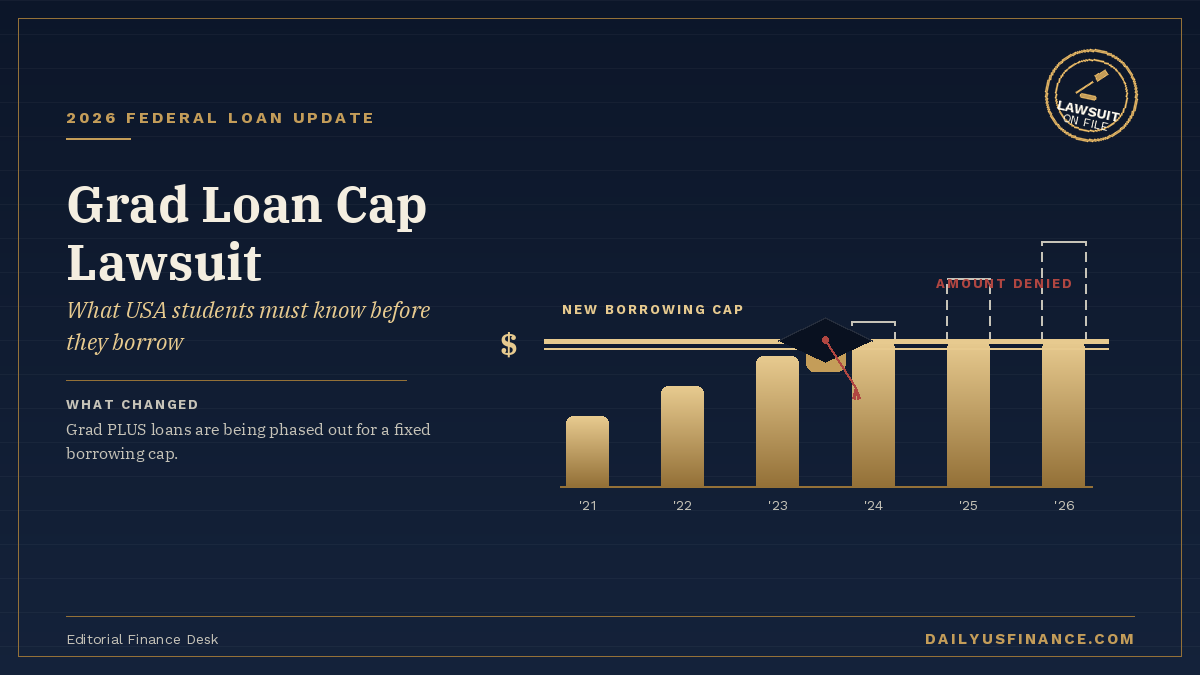
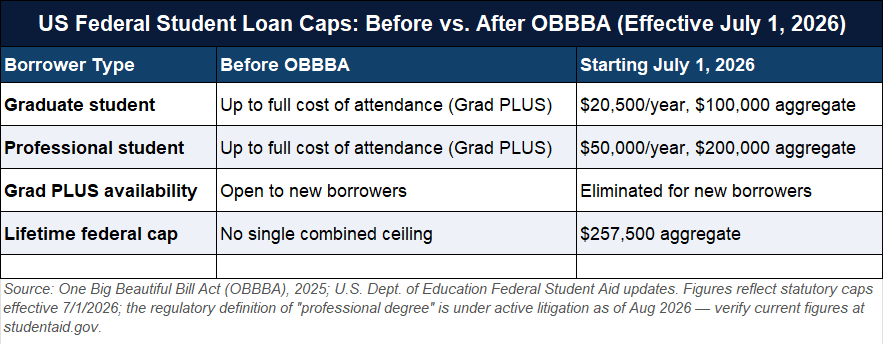
Regardless of how the lawsuits end, the underlying borrowing caps set by Congress are already in effect as of July 1, 2026. These are the numbers every US student loans borrower needs on hand right now:
- Graduate students: $20,500 per year, $100,000 aggregate
- Professional students (medicine, law, dentistry, pharmacy, veterinary medicine, and similar): $50,000 per year, $200,000 aggregate
- Lifetime aggregate cap on all federal student loans (excluding Parent PLUS): $257,500
- Parent PLUS loans: capped at $65,000 per dependent student
- Grad PLUS loans: eliminated entirely for new borrowers starting July 1, 2026
Before OBBBA, most graduate and professional students could borrow up to their full cost of attendance through the Grad PLUS program, with no hard dollar ceiling. That flexibility is gone. Because these figures are set in statute and could still be adjusted through future rulemaking or legislation, check studentaid.gov or your school’s financial aid office for the current confirmed numbers before finalizing your borrowing plan.
Old Rules vs. New 2026 Rules
Why Are States and Healthcare Groups Suing the Department of Education?
They’re suing because ED’s narrowed definition would have pushed thousands of graduate students — many in healthcare — into the lower $20,500 tier instead of the $50,000 professional tier, even though their fields require licensure and advanced clinical training. The dispute centers on one legal question: how much room did Congress leave ED to redefine “professional degree”?
The State Coalition Lawsuit
A coalition led by Maryland, Colorado, Nevada, and New York attorneys general — joined by roughly two dozen other states and D.C. — filed State of Maryland v. U.S. Department of Education in federal court in Maryland on May 19, 2026. The suit argues ED’s rule conflicts with the statutory text Congress used and could worsen existing healthcare workforce shortages.
Maryland Attorney General Anthony Brown put it directly in a public statement, saying the rule forces students choosing careers like nursing or physical therapy to decide between costlier private loans or walking away from their chosen career.
The Healthcare, Education, and Union Lawsuits
Separately, the American Association of Nurse Practitioners and the Physician Assistant Education Association filed suits (later consolidated) in the U.S. District Court for the District of Columbia, seeking emergency relief before the July 1 deadline. Most recently, on August 11, 2026, a coalition led by the American Federation of Teachers filed a fourth suit on behalf of public-service and healthcare unions, covering fields like advanced practice nursing, public health, social work, and library science.
“how Trump Accounts could affect your long-term savings as a student”
Fields excluded from ED’s narrower “professional” list include:
- Nurse practitioner and other advanced nursing degrees
- Physical therapy (DPT programs, which can run up to $228,452 according to the American Physical Therapy Association)
- Physician assistant studies
- Social work
- Public health
- Marriage and family therapy
- Library and information science
- Are the New Loan Caps Currently Blocked? (Legal Status as of August 2026)
Partly — but not the way most students assume. On June 24, 2026, the U.S. District Court for the District of Columbia issued a nationwide preliminary stay blocking ED’s narrowed five-part “professional degree” test. The court did not block the underlying dollar caps ($20,500/$50,000) or the Grad PLUS elimination, since those come directly from the statute, not from ED’s rule.
In practice, this means:
- The $20,500 graduate / $50,000 professional loan caps are in effect right now.
- Grad PLUS loans are no longer available to new borrowers.
- ED’s narrow definition of “professional degree” is on hold, and the agency is temporarily using a broader, interim list of 20+ qualifying programs — including registered nursing, physician associate programs, and speech-language pathology — while the case continues.
- No final ruling on the merits has been issued, and legal observers expect the case to stretch on for months, with a possible appeal to the D.C. Circuit or even the Supreme Court.
How Do the Grandfathering Rules Work for Students Already Enrolled?
If you had a federal loan disbursed before July 1, 2026, and you stay in the same program without interruption, you’re generally protected from the new caps for up to three academic years or until you finish your program, whichever comes first. Miss that continuity, and the protection disappears.
Key rules to know:
Eligibility cutoff: You (or your program) must have been enrolled and borrowing as of June 30, 2026.
Protection window: Legacy status lasts a maximum of three academic years or your remaining time to complete the program.
What breaks it: Transferring schools, withdrawing and re-enrolling, or switching degree programs — even within the same field — can disqualify you from legacy protection.
This is contested too: The state coalition lawsuit specifically challenges ED’s re-enrollment disqualification rule, arguing Congress only required enrollment as of June 30, 2026, with no exclusion for later transfers.
What Should USA Students Do Now to Plan Their Loan Borrowing?
Don’t wait for the lawsuits to resolve before making a financial plan — build a plan that works under either outcome. Here’s a practical checklist:
- Confirm your current classification. Ask your financial aid office whether your program currently counts as “graduate” or “professional” under ED’s interim list.
- Recalculate your funding gap. If your program costs more than your new federal cap allows, price out private loan options early, since approval and rate-shopping take time.
- Protect your legacy status. If you already have loans, avoid unnecessary transfers, withdrawals, or program switches until the litigation settles.
- Track your lifetime aggregate. Add up prior undergraduate and graduate borrowing against the $257,500 combined cap so there are no surprises senior year.
- Watch official sources, not headlines. Bookmark studentaid.gov’s Federal Student Aid Updates page and your school’s financial aid announcements — the interim professional-degree list can change as the case moves forward.
- Talk to a financial aid advisor before this fall’s disbursement, especially if you’re in nursing, PA studies, social work, or another currently disputed field.
“Credit Card Debt Statistics 2026: Why You Can’t Save Money”
Frequently Asked Questions
Are graduate student loan caps in effect right now?
Yes. The $20,500 annual/$100,000 aggregate cap for graduate students and the $50,000 annual/$200,000 aggregate cap for professional students took effect July 1, 2026, and remain in force. Only the Department of Education’s narrower definition of “professional degree” is currently blocked by a court order.
Is the Grad PLUS loan program still available?
No. Grad PLUS loans were eliminated for new borrowers starting July 1, 2026, under the One Big Beautiful Bill Act. Borrowers with a Grad PLUS loan disbursed before that date may continue borrowing under legacy rules for up to three years or until program completion.
Does the lawsuit affect nursing and physician assistant students?
Yes, directly. ED’s original rule excluded nursing, PA, and several other healthcare fields from the higher professional loan tier. A federal court stay currently keeps these fields on an interim “professional” list, but that could change once the case is fully decided.
When will the student loan cap lawsuits be resolved?
There’s no confirmed date. As of August 2026, legal observers expect the case to continue for several more months, with a possible appeal to a federal circuit court. Students should not assume the current interim rules are permanent.
What is the lifetime student loan borrowing limit in 2026?
The combined lifetime cap on federal student loans (excluding Parent PLUS) is $257,500, covering both undergraduate and graduate/professional borrowing. Parent PLUS loans carry a separate $65,000-per-student lifetime cap.
Author:
About the Author This article is brought to you by Allwin, founder of Sunviz Consultant and creator of DailyUSFinance.com, where he covers US personal finance, student loan policy, and money trends for students and working professionals.
- Trump Account vs. 529 Plan: Which Wins in 2026?
 In this article Trump Account vs. 529 Plan: Which Should You Use in 2026? What Is a Trump Account, and…
 - Retirement-Maxxing: Best Way to Max Your 401(k) in 2026In this article Retirement-Maxxing: What It Is and How to Max Out Your 401(k) in 2026 What Is Retirement-Maxxing? Why…
- Trump Accounts for Kids: Complete 2026 Parent GuideIn this article Trump Accounts Explained: Complete 2026 Parent's Guide Where Things Actually Stand as of August 2026 Who Qualifies…
- Trump Account Employer Match: Real Tax Savings 2026In this article Trump Account Employer Match 2026: Real Tax Savings by Income What Is the Trump Account Employer Match,…
- Credit Card Debt: Compare 0.99% vs 0% APR CardsIn this article Balance Transfer Cards Compared: Who Actually Qualifies to Tackle Credit Card Debt at 0.99% vs. 0% APR…