“Quick Answer: Credit card debt forgiveness usually means debt settlement, not a government program — a creditor agrees to accept less than you owe (often 40–60% of the balance) as payment in full. The forgiven amount is generally taxable as income, and settlement typically drops your credit score 50–150 points for up to seven years, though most people recover within 12–24 months.”
Credit card debt forgiveness in 2026 means negotiated settlement, not a government program. Learn the tax bill, credit impact, scams, and alternatives.
Credit Card Debt Forgiveness in 2026: What It Actually Means
If you’re searching for credit card debt forgiveness, you’re probably picturing something like student loan forgiveness — a program that simply erases what you owe. That’s not how it works. Credit card debt forgiveness in 2026 almost always means debt settlement: a negotiated agreement where a creditor agrees to accept less than the full balance as payment in full. It can genuinely reduce what you owe, but it comes with a tax bill, a credit score hit, and a real risk of scams that most short explainers skip entirely.
This guide covers what those other explainers leave out — the IRS treatment of forgiven debt, exactly how much your credit score drops and for how long, how settlement compares to nonprofit credit counseling and bankruptcy, how to spot a predatory operator, and — since a large share of U.S. credit card holders are immigrants or visa holders — whether any of this touches your immigration status.
Click here for: Credit Card Debt Statistics 2026: Why You Can’t Save Money
What Is Credit Card Debt Forgiveness?
Credit card debt forgiveness is when a creditor or debt collector agrees to cancel some or all of a balance you owe, usually in exchange for a lump-sum payment that’s smaller than the full amount. There’s no federal “credit card debt forgiveness program” the way there have been targeted student loan discharge programs — this is a private negotiation between you (or someone representing you) and each individual creditor.
- It’s account-by-account, not a single application that wipes out everything you owe.
- It typically only happens after you’ve fallen behind, since creditors have little incentive to negotiate on accounts you’re paying on time.
- The forgiven amount doesn’t just disappear from a tax standpoint — more on that below.
How Does Credit Card Debt Settlement Actually Work?
Debt settlement works by redirecting money you’d otherwise spend on minimum payments into a separate savings account, then using that lump sum to negotiate a payoff once it’s built up enough to make creditors take the deal seriously.
Doing It Yourself
You can call your creditor directly, explain your hardship, and offer a lump sum (often 40–60% of the balance, though this varies widely by creditor and account age). This avoids third-party fees entirely, but it requires having cash on hand and negotiating without leverage or experience.
Using a Debt Settlement Company
A for-profit debt settlement company enrolls your debts, has you stop paying creditors directly, and instead deposit funds into a dedicated account. Once enough has accumulated, the company negotiates settlements one account at a time. Two things to know going in:
Under the FTC’s Telemarketing Sales Rule, a for-profit settlement company cannot legally charge you a fee before it actually settles a debt — any company asking for money upfront is breaking the law.
Stopping payments means your accounts will go delinquent and likely get charged off while you wait for a settlement, which is part of why this path damages your credit.
Is Forgiven Credit Card Debt Taxable in 2026?
Yes — this is the part most short articles on this topic skip entirely. When a creditor forgives $600 or more of debt, they’re required to send you (and the IRS) a Form 1099-C, and the IRS generally treats that forgiven amount as ordinary taxable income, not a windfall you get to keep tax-free.
Threshold: $600 or more in canceled debt triggers a 1099-C from the creditor.
How it’s taxed: The forgiven amount is added to your income for that tax year and taxed at your regular marginal rate — it can even push you into a higher bracket.
The insolvency exception: If your total debts exceeded the fair market value of your total assets at the time of settlement, you may qualify to exclude some or all of the forgiven amount using IRS Form 982, under the insolvency provisions in IRS Publication 4681.The bankruptcy exception: Debt discharged in bankruptcy is generally excluded from taxable income entirely.
Because the taxable amount depends on your full financial picture, this is genuinely worth a conversation with a tax professional before you sign a settlement — not after you’ve already spent the money you thought you saved. Tax rules and thresholds can shift year to year, so check current IRS guidance for the filing year in question.
How Much Does Debt Settlement Actually Hurt Your Credit Score?
Debt settlement typically drops your credit score somewhere in the 50 to 150 point range, with the size of the drop depending heavily on how strong your score was before the missed payments started piling up. A “settled for less than full balance” notation stays on your credit report for seven years from the date of your first missed payment, though its effect on your score fades well before that.
Most people see meaningful recovery within 12 to 24 months if they keep new accounts current and utilization low afterward.
If your score was already damaged by months of missed payments before you settled, the additional drop from the settlement itself tends to be smaller — the real damage was already done by the delinquency.
Some creditors report a settled account as “paid” rather than “settled for less than owed,” which is friendlier to your score — it’s worth asking for this in writing before you agree to terms.
Click Here for: How 2026 Tariffs Could Affect Your Grocery Bill
What Are the Alternatives to Debt Settlement?
Settlement isn’t the only way out of credit card debt, and for many people it isn’t even the best-fitting option. Here’s how the three main paths compare:
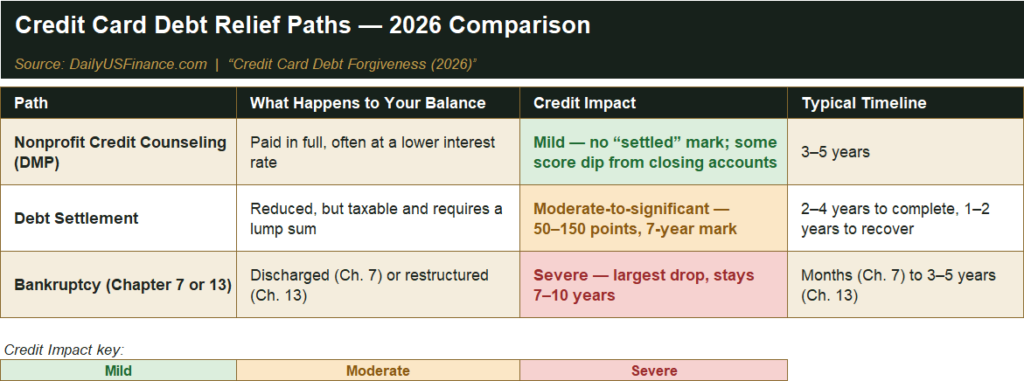
A debt management plan (DMP) through a nonprofit credit counseling agency accredited by the NFCC or FCAA is often the first stop worth taking, since the initial consultation is free and doesn’t affect your credit. A counselor negotiates lower interest rates with your creditors — not a reduced balance — and consolidates your payments into one monthly bill. Bankruptcy becomes the more realistic option when your income genuinely can’t support repaying even a reduced balance within a few years; it’s a bigger initial hit to your credit but offers legal protections settlement doesn’t.
How Do You Avoid Credit Card Debt Forgiveness Scams?
The debt relief space attracts a disproportionate number of scammers, and the FTC and CFPB have both taken enforcement action against operators who impersonated banks and government agencies to defraud people already in financial distress. Watch for these red flags:
Upfront fees before any debt is actually settled — illegal under the FTC’s Telemarketing Sales Rule for for-profit companies.
Guaranteed results, like a specific “cents on the dollar” promise — no legitimate company can guarantee what a creditor will agree to.
Instructions to stop communicating with your creditors entirely, rather than just redirecting payments.
Official-looking mail or calls referencing vague “federal debt relief” programs or government seals.
Pressure tactics or unsolicited calls, including, increasingly in 2026, AI-generated voice calls impersonating your bank.
Before signing anything, verify a company’s licensing with your state attorney general’s office and check the CFPB’s and FTC’s complaint databases. A free session with an NFCC-accredited nonprofit credit counselor is a low-risk way to sanity-check any offer you’ve received.
Does Settling Credit Card Debt Affect Your Immigration Status or Visa/Green Card Application?
In almost all cases, no. Ordinary civil debt — including credit card balances, whether paid, settled, or unpaid — does not directly affect visa status, green card eligibility, re-entry to the U.S., or naturalization. Immigration law treats unpaid consumer debt very differently from criminal conduct.
- Public charge rule: This mainly applies to certain green card applications and evaluates whether someone is likely to rely on specific public benefits — it does not evaluate your credit score or consumer debt directly, though overall financial stability can be one factor among many an officer weighs.
- Naturalization (“good moral character”): Actively working to resolve debt is generally viewed as a positive sign, not a red flag, during citizenship review.
- The one real exception: Debt tied to fraud — credit card fraud or identity theft, for example — is treated as a crime and can carry immigration consequences. Ordinary unpaid or settled debt is not fraud.
- Rules can shift: Public charge policy has changed by administration before and proposed changes were under federal review in late 2025. If you’re mid-process on a visa or green card application, confirm current USCIS guidance or speak with an immigration attorney rather than relying on general debt-relief advice.
Frequently Asked Questions
Is there a government credit card debt forgiveness program in 2026?
No. Unlike targeted student loan relief programs, there is no federal program that forgives credit card debt. “Forgiveness” in this context refers to privately negotiated debt settlement with individual creditors.
Do I have to pay taxes on forgiven credit card debt?
Generally yes — the IRS treats forgiven debt of $600 or more as taxable income, reported on Form 1099-C, unless you qualify for an exception such as insolvency (Form 982) or bankruptcy discharge.
How many points does debt settlement drop your credit score?
Typically 50 to 150 points, depending on your starting score and how many accounts are involved, with the settlement remaining on your report for seven years and most people recovering meaningfully within 12 to 24 months
Is debt settlement better than bankruptcy?
It depends on whether your income can realistically support paying a reduced lump sum. Settlement is generally a smaller, shorter-lived credit hit than bankruptcy, but bankruptcy offers legal protections and can fully discharge debt that settlement can’t guarantee.
Will settling credit card debt affect my green card or visa application?
Almost never directly — ordinary credit card debt isn’t evaluated as immigration fraud or a crime. It could be one minor factor in a broader “public charge” financial review for certain green card cases, but it doesn’t disqualify you on its own.
About the Author:
Allwin is the founder of DailyUSFinance.com, where he writes about credit, debt, and everyday money decisions for immigrants, visa holders, and U.S. consumers navigating the American financial system.
- Trump Account vs. 529 Plan: Which Wins in 2026?
 In this article Trump Account vs. 529 Plan: Which Should You Use in 2026? What Is a Trump Account, and How…
 - Retirement-Maxxing: Best Way to Max Your 401(k) in 2026In this article Retirement-Maxxing: What It Is and How to Max Out Your 401(k) in 2026 What Is Retirement-Maxxing? Why Is…
- Trump Accounts for Kids: Complete 2026 Parent GuideIn this article Trump Accounts Explained: Complete 2026 Parent's Guide Where Things Actually Stand as of August 2026 Who Qualifies for…
- Trump Account Employer Match: Real Tax Savings 2026In this article Trump Account Employer Match 2026: Real Tax Savings by Income What Is the Trump Account Employer Match, Exactly?…
- Credit Card Debt: Compare 0.99% vs 0% APR CardsIn this article Balance Transfer Cards Compared: Who Actually Qualifies to Tackle Credit Card Debt at 0.99% vs. 0% APR What's…